"Now more than ever do I realize that I will never be content of a sedentary life on the surface, I will always be haunted by thoughts of being drenched elsewhere"….
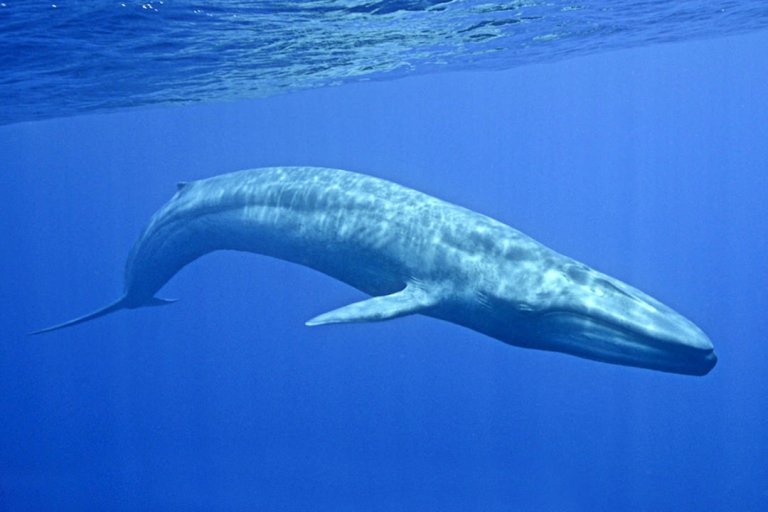
The Blue Whale (Balaenoptera musculus)is the largest animal that ever lived on Earth. They can grow to 30 meters, weigh up to 181 metric tons and live 80-90 years.
Status:
Endangered (World Conservation Union Red List) due to rampant whaling in the 1960s.
They feed mostly on krill (tiny shrimp like animals) and can consumer around 3.6 metric tons in a day.
They belong to the baleen whales. Baleens are fringed plates of fingernail-like material attached to their upper jaws. They feed by swallowing mouthful of water and expelling these through the baleen which acts as filter that trap the krill.
Blue whales are graceful swimmers and cruise the ocean at more than eight kilometer per hour, but accelerate to more than 32 kilometers an hour when they are agitated.
Blue whales are among the loudest animals on the planet. They emit a series of pulses, groans, and moans and it is thought that, in good conditions, blue whales can hear each other up to 1,000 miles (1,600 kilometers) away.
THEY ARE ENDANGERED
Their huge size does not spare them from human threats.
They are threatened by boat collision. Dynamite fishing, marine debris entanglement, plastic trash pollution, chemical and sound pollution.
WHAT YOU CAN DO TO HELP SAVE THEM
Help spread awareness about conserving and protecting our marine resources.
Report illegal fishing activities.
Reduce your plastic waste.
Help document presence of whales and other large marine life (do this from a safe distance).
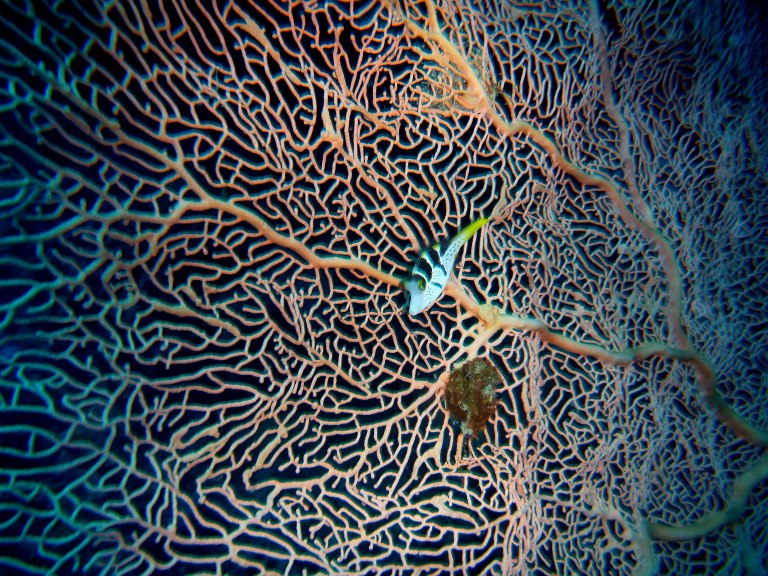
This dwarf puffer fish (Carinotetraodon travancoricus) was lost in the comfort of this wide giant gorgonian, perhaps it swam directly in the midst of humongous fan and was trap in a maze like in a net! I caught up with it while swimming in a wall in the marine sanctuary of Sumilon Island, Cebu. Another example of symbiotic relationships in marine world!
Our quest for off beaten sites is still going on, that spirit of curiosity is never put to rest and so we continue to explore and hunt from island to island. And most often such locations are remote, far-flung and most likely unheard of in terms of tourism radar. The town is off the national highway en route to other Surigao Sur municipalities. It is practically off-road, a separated land mass like an annex facing directly the Pacific Ocean.
I met up with Angel in Tandag after sleepless rides and again, it was another long trip for almost ten hours. Saturdays or weekends for that matter are always in a relaxing mode for the town folks but fortunately there were people in the Tourism Office just beside the Kujaw Diveshop, perhaps due to forthcoming national elections. We waited for our contact Archie (an LGU staff) who made arrangements for the day’s dives, he lives in a barangay outside the town.
Kujaw Depths
Our first descent was in Poblacion, it was yet high tide, but water movements shifting for the low tide was intense, carrying one back to the shallows, finning hard was necessary and it was just exhaustive! The visibility wasn’t good enough, there had been rains in the past few days and it was fortunate that it was sunny! We found pipefish, Moorish idol, angels, triggerfish, snappers and unicorn fish. There was these three snappers who were inseparable and keep by side near me, perhaps they were siblings and was wondering what kind of black fish I am. 🙂 And there was a herd of barracuda somewhat obscure from my point, which Angel tried to swim after, I thought it was trevally! We went around, found a patch of branching corals, and the white sand ripples underwater brought by the water movements. After 45 minutes we ascend, our deepest at 18.2 meters.
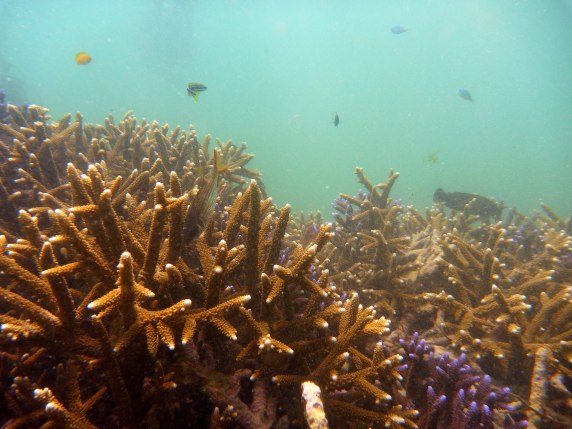
A field of branching corals obviously competing with one another
Our surface interval was spent on the boat, Jun and Ramil (our guides) have lot of stories about Cortes and its efforts in the preservation and protection of its marine environment. They were all praises for their Mayor (vehemently against mining), they recalled that dynamite fishing was a common practice even in neighboring towns. Now, the surrounding waters is teeming with fish life. The fisher folks need to observe the spawning season, strictly no fishing is allowed during the period and they perfectly understood the reason. The local government labored for the information and education campaign, respectively livelihood projects were initiated for the people.
Giant clams abound in the area
Our second descent was in Uba Marine Sanctuary, the current was still moving as the water recede for the low tide. There were rock formations, some cavern and crevices. There were variety of anthias, clown fish and herds of yellow breams. There was patch of sea grasses, which I keep holding on as I went around, the waves current is pushing me back. We went round and round in the shallows. After 63 minutes, I signaled for ascent as the tide movements was getting rough.
Kujaw Side-trips
After checking in our refuge, we make most of the remaining time in the afternoon. We were aiming for the Laswitan Lagoon, the town has been known for this natural wonder. The gigantic waves from the Pacific whip up the rock formation along the coast, creating like Falls. It was not in season anymore so what we got were clear pools trapped by rock formations. The good thing was it was calm and so serene, it was not filled with people. It was already late, but our guide still made us to Lubcon Falls. Just a bit off the highway near the boundary to next town, a small dirt road led to this small falls. Its cold waters was refreshing enough after a long day. It was almost dark and it was all to ourselves, our dip was quick but the sound of the gushing waters was a calming assurance of nature’s peace and tranquility, like a soothing balm for weary souls.
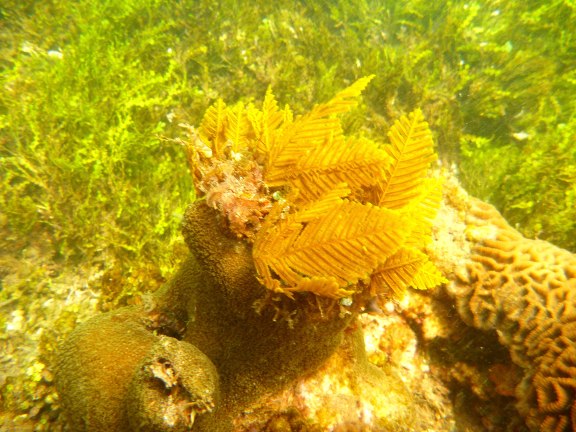
Such a welcome from a purple/yellow tree worm!
Everything in Cortes is about simple living obviously not yet spoiled by technology advancement and so called development.
Unconsciously I mentioned Cortes as my latest destination in one of work chitchats and they were asking where? Sometimes even locals are surprised such unheard town can have wonderful marine environment. I almost joked it is in Mexico!
NO, this obscure town is not struggling for visibility, but the sincerity of the local officials and the cooperation of its people have made this community compliant to sanitation, environmental preservation & protection issues that are required for coastal communities. Cortes has been afforded numerous awards including the Para El Mar MPA Award as one of the most outstanding MPA in Mindanao (for Uba Marine Sanctuaty). This humble town is undoubtedly worthy for a visit, you wont go home empty -hearted! 🙂
Travel Notes:
My route for this trip: To Cortes: CdeO to Butuan by AC bus (10PM) – 4.5 hours
Butuan to Tandag by ordinary bus – 5 hours
Tandag to Cortes by multicab – 30 minutes From Cortes: Cortes to Tandag by multicab
Tandag to San Francisco (Agusan Sur) by AC van
San Francisco to Butuan by AC bus
Butuan to CdeO by AC bus
Lodgings available in town are limited to Kamalig (home stay) and the guest house of Philippine Independent Church, advance bookings necessary.
Dive bookings are handled by Kujaw Diveshop, a LGU operated diving facility housed just beside the Municipal Tourism Office. They have boat, complete diving gears, tanks and compressor for air refilling
Other natural spots in town worth visiting are beaches, caves, Lubcon Falls, and Laswitan Lagoons/Falls in which the town is known for
Single motors and habal-habal are available for hire for transport needs.
Kujaw is a Surigaonon word for kuyaw (Visayan) which means dreadful, horrible, alarming, appalling or shocking but for Cortes in a positive way
The Kujaw Team who assisted us in our trip and whom we are grateful were Archie, Jun, Ramil and Elpedio
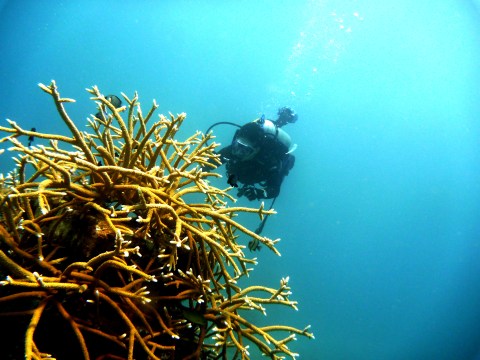
This blooming branching corals can only be seen in the depths!
Just recently I came across an article about scuba addiction citing all the symptoms of being one, bit hilarious but in a sense there some truth in it. For many and that includes me, has been bitten by the bug, and again I would say this could last a lifetime. In my own terms, it’s not addiction but more of passion, not an obsession but fervent devotion, not merely fancy but true admiration of the life beyond.
The lure of the underwater world sets a diver on a great voyage that goes to the bottom of the sea. A journey beyond the terrestrial dimension that set him apart from the rest after such glorious experience in a universe populated by weird or wonderful cast of thousands.
So in many ways, our passion would manifest in our behavior, habits that could become a lifestyle. Generally, there is nothing verbal but in many subtle ways the assertion is essentially clear of being a true blood diver.
Sporting a bulky watch even for women is not weird, because the dive computer will become one’s treasured time-piece. Now, I found it practical to wear my dive computer on my other trips other than diving, even if I went on my weekend walking. It has practically become my buddy!
My so called de-stressor trips revolve around dive plans, seeing one new place is something therapeutic for me but it must have dive sites and obviously dive operator. My official trips sometimes are coupled with a dive plan if such destination has diving opportunities.
Yes, my certification cards are in my wallet (all three of them), just to keep them handy. It might get misplaced if I keep it somewhere else!
I can have all my essentials in my back pack but I do always get extra kilos exclusively for my gears, always requesting the airline crew for tagging as “fragile”. Extra time is necessary for some questions and signing the waiver.
Well, incredible memory is necessary – for all the story telling what was seen underwater. The key is being mindful for those amazing moment, it is needed for taking notes on your log not only for sightings but more importantly for the lessons learned. You can always narrate when you saw your first shark, turtle, ray or whale. Or mention a site, and you can always tell stories what not to miss. 🙂
Learning and knowing an extra language in hand signals. You have leveled up actually, the “OK” sign is not about money anymore, or the “thumbs up” is always about going up. You easily get confused when such signals are used on the surface!
If these are not weird and all sound too familiar for you, then you are a diver by heart, the depth of your passion has sunk in your innermost being. Needless to say, if you don’t have these qualities, you’re not a real diver. Chances are, it was merely a whimsical urge which after a time, when the excitement wane it will become a thing of the past. A passé but never a passion….
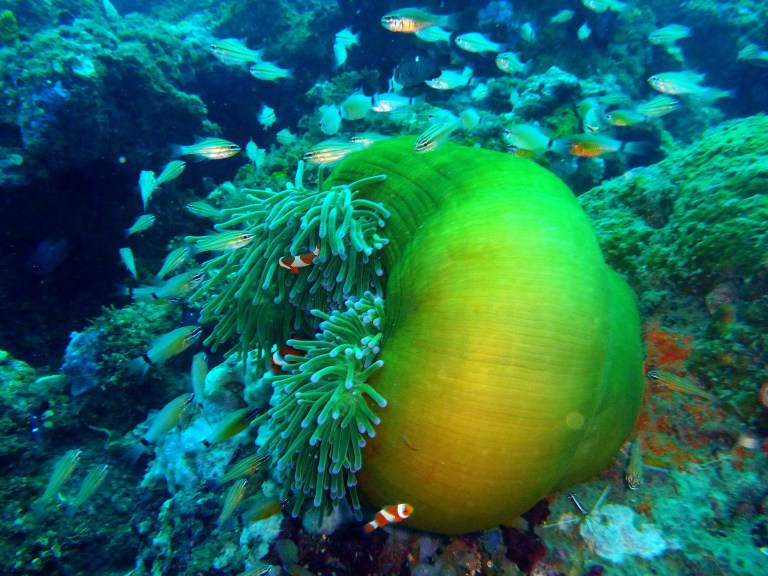
Spotting a pair of clownfish underwater always means they are near an anemone or most likely swimming and playing hide and seek over a bloom of anemone. Anemones are named after a terrestrial flower, but it’s actually a marine animal.
Of the over 1,000 anemone species that live in the ocean, only 10 species coexists with the 26 species of tropical clownfish. Within these species, only select pairs of anemone and clownfish are compatible. Together, they are obligatory symbionts, which means that each species is highly dependent on the other for survival. Symbiosis between the two species is achieved in a variety of ways including a mutual protection from predators, an exchange of nutrients, and the clownfish’s tolerance of anemone nematocysts.
The relationship between the sea anemone and clownfish allows the other to flourish through symbiosis. They are mutually dependent from each other. The above explosion of colors was in Mag-aba Deep Wall in Pandan, Antique!





 Life in the Great Beyond
You must be logged in to post a comment.