"Now more than ever do I realize that I will never be content of a sedentary life on the surface, I will always be haunted by thoughts of being drenched elsewhere"….
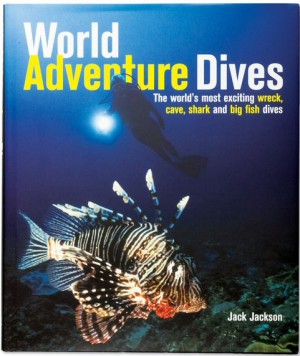
I got one more dive guide from Jack Jackson, this book wasn’t confined in one region but covered around the world on sites for adventure – that is for wreck, cave, shark and big fish dives.
One of dive experts, Jackson presents exhilarating and adrenaline dives in underwater environments around the world. Not only in photos but also background and locator maps that will help and guide lest one need to plan a trip to these sites.
Of course, sites in the Philippines can never be spared in fact my favorites – Puerto Galera, Coron WWII Wrecks and Tubbataha Reefs!
Fun isn’t important, purpose is, and actions that have some real meaning…
Silence… My own breathing… Bubbles. Holding on to a rope, descending, slowly. Nothing in sight, just waters and the sound of my breathing. There was only stillness as I went unto depths. Just few minutes back, there was turmoil on the surface and I was out of breath as I swam for the line. I was gasping, my mind racing just wanting to cancel my dive. But my dive guide was firm and with controlled voice plainly told me to hold the line.
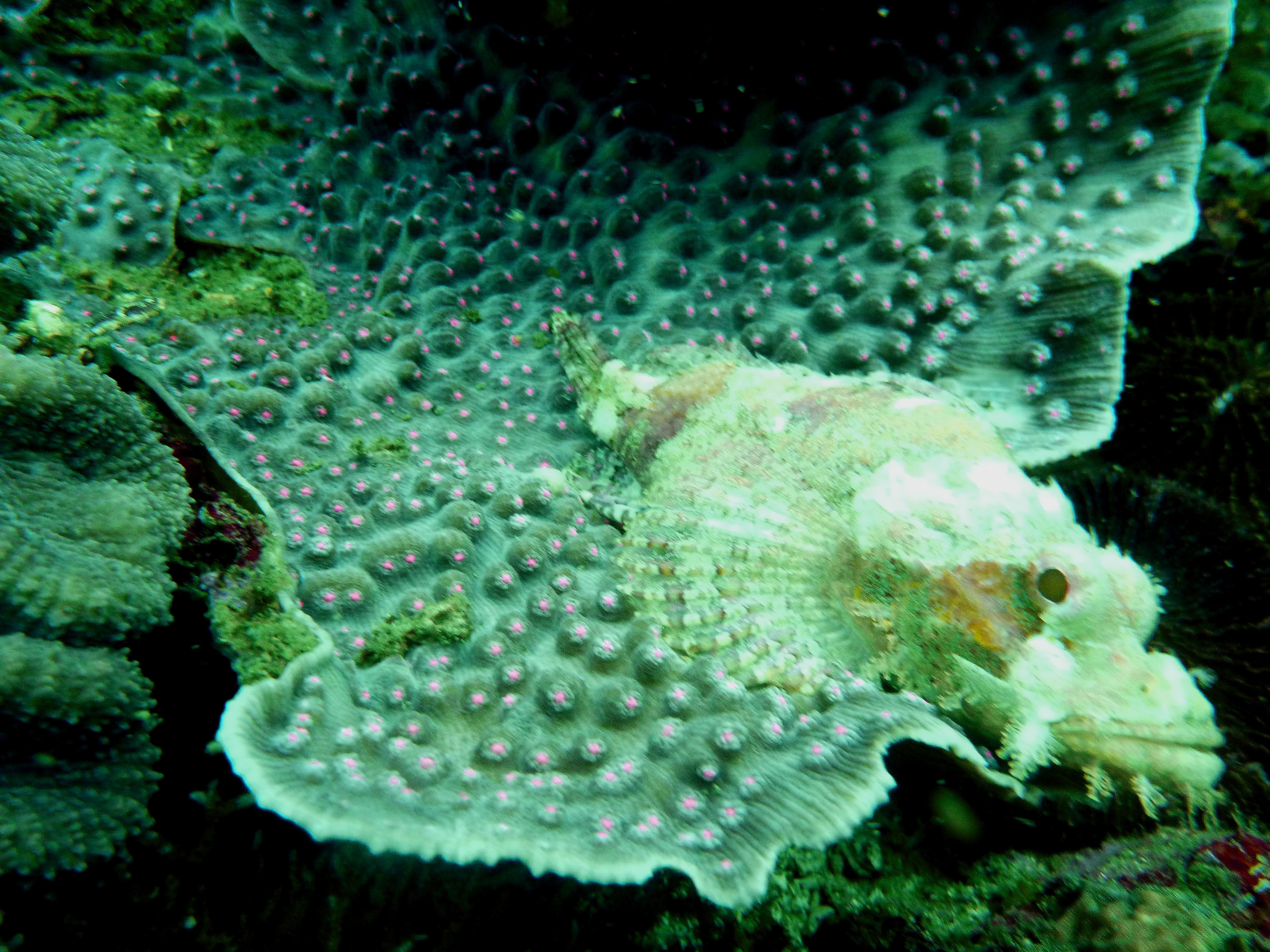
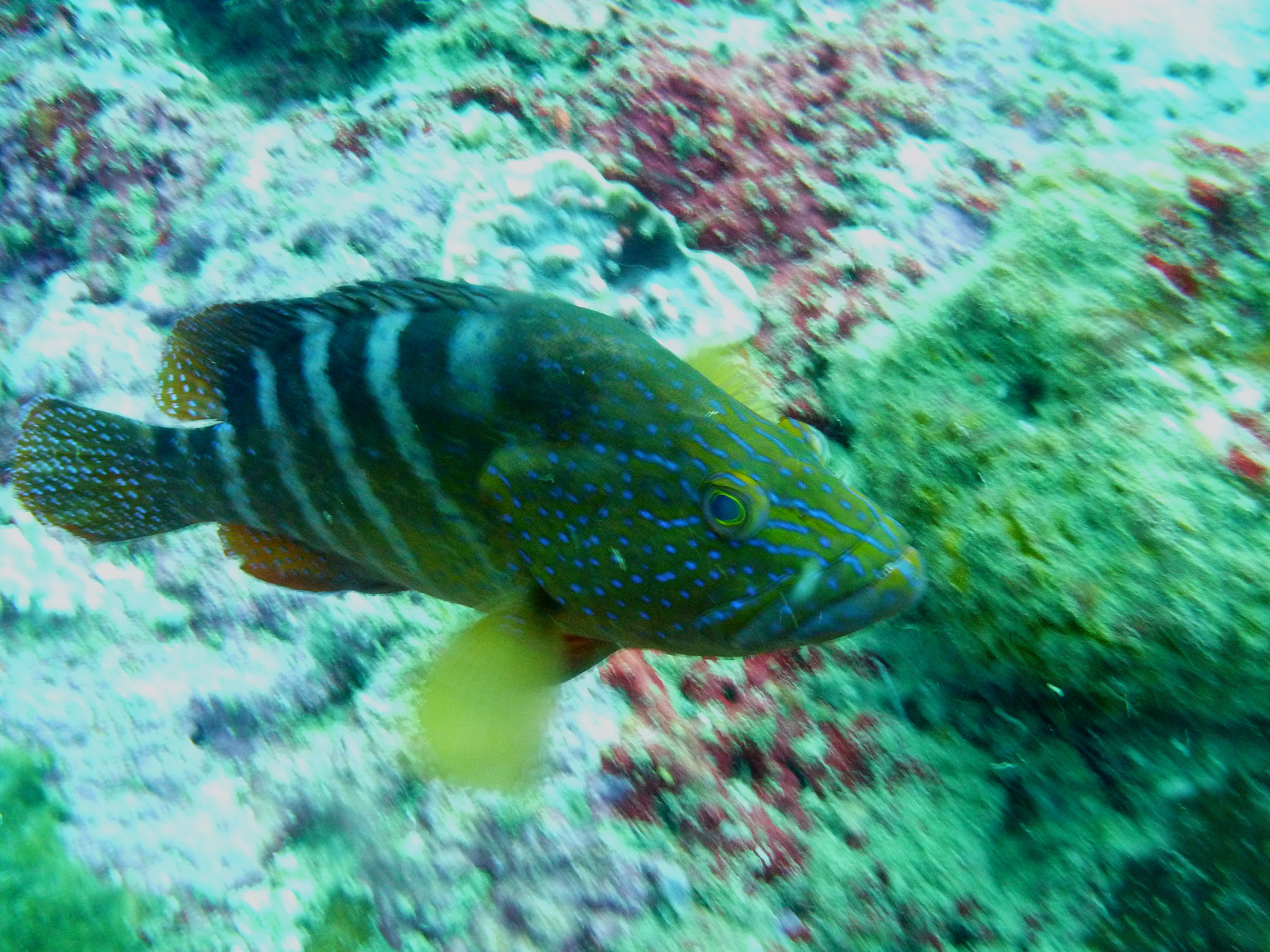
Banaug Shoal is 22 meters depth, in between was all waters with no sign of life – there was only pure silence. Slowly descending to this underwater hill is like stepping into the unknown hoping to land on a paradise. Indeed it is, a self-contained spot with so much life. The damsels swarmed us, the couple red snapper followed not wanting to be left behind. There was a display of resident species – angels, seargents, anthias, lionfish and more. The reef is colourful as it was, we found a leaf fish which is something new to me, I thought for awhile it was a scorpiofish! There were nudis too –
Leaf fish at the shoal – new to me!
black/white combi was new. The resident scorpionfish still sitting on the coral top – just waiting for a prey. But I missed the big moray eel, he didn’t show up from his hole. I was wondering if he was just watching us from under the rocks. Lingered for more basking in the presence of the shoal’s residents but when my NDL got at four minutes, I signalled to the dive guide for the ascent after 51 minutes with air still at 80 bars. Speeding back to the resort, I was left alone by the staff after we agreed for the 1 pm second descent. The good thing was there was no other guests for the day, the place was all to myself totally.
The resident scorpionfish on coral top
Silence… Sitting by the waterfront reading my book, the withered talisay leaves collected my feet as the noon winds blew under the trees.
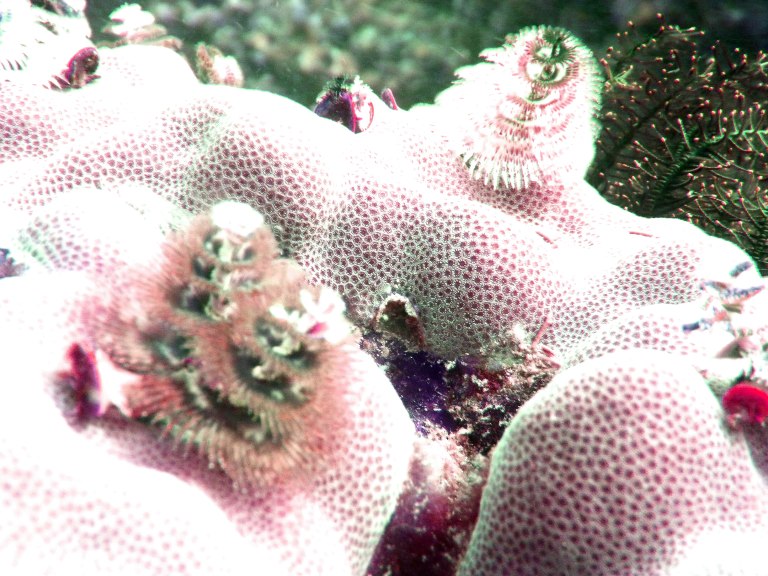
The waters became fiercer so the next descent as explained by the guide is at Lapinig Island instead of Talisayan Shoal, to take refuge from the raging waves of the open sea. Speeding off, I was hoping the current would be manageable. Again, this lowly island never disappointed me, we descend on a sandy slope and slowly swam taking my time observing the rich colourful secrets of its depths. We got to a coral area hosting Christmas tree worms creating a miniature holiday scene. Many of them quickly hid in their holes as I drew near but few of them was generous enough, stood their ground as I took photos. There were colourful nudis, cleaner shrimp on anemones, clownfishes, anthias and more. The highlight of which was an encounter with a cuttlefish. Most often, they would just quickly disappear from sight, but this one
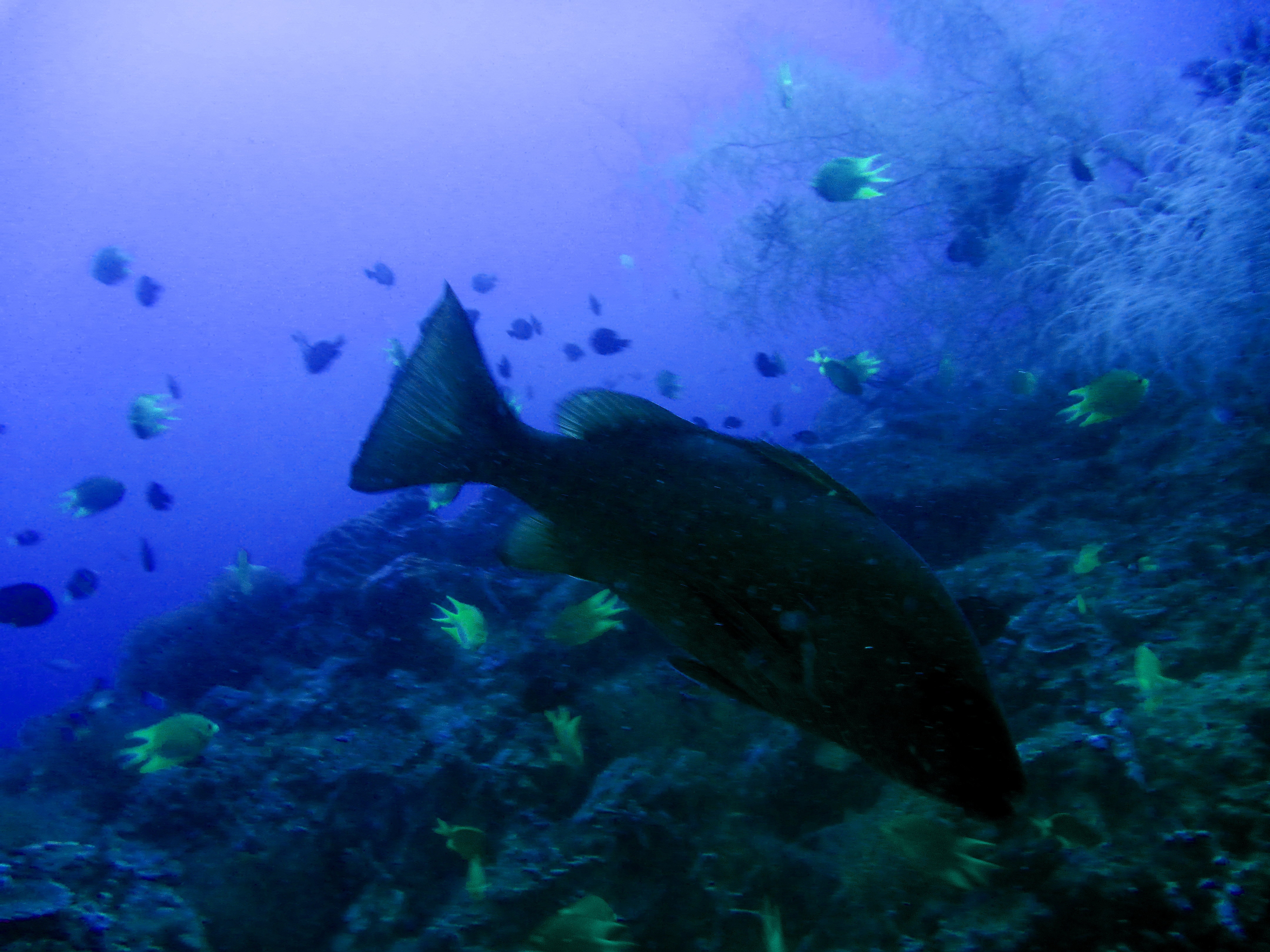
The grouper wanting to be fed!
choose to stay nearby in a way observing us too. I was inching my way nearer but he was backing off inch by inch too maintaining its distance! Such magnificent animal. For awhile we float face to face, its fins wiggling around him as it swam backwards. I gathered a handful of trash as we went around, as every descent is a clean-up one. I needed keen eyes for this. The current has gotten stronger as we went shallower, I have to hold on to the coral rocks to maintain my depth during my safety stop – I was swept away up. We surface after 61 minutes with my air at 80 bars, the waves surging on and the waters fiercer. The cold sea air sweeping us and the salt water spraying us, as we sped off for the shores, watching the horizons in silence. It felt good.
Christmas tree worm in white and yellow
Coming home to MADRI and spending time in its nearby depths in silence is one best way to revive my sagging spirits and to brace me for the daunting year-end tasks. Just pure and natural silence.
Banaug Shoal and Lapinig Island are indeed a paradise deep down, and always will be. I had a rich encounter in my last dive with its residents, they always welcome my presence. I can always come back again and again, yet each time is always a new experience!
The Christmas tree worm (Spirobranchus giganteus) created a miniature holiday scenery beyond the depths of Lapininig Island, scattered all over a patch of coral rocks. The above pinkish pair was generous enough, stood their ground for some snapshot!
My last dive beneath the lowly Lapinig Island lead me to discover and know closely the elusive cuttlefish. This specie is so fast or was I so slow I never got glimpse of them in the wild, previous dives left me oblivious with only the dive guide or my dive buddy mentioning the sightings as we got to the surface. The cold waters embraced me and while looking over the reef with hovering fishes, my dive guide caught my attention pointing beyond. There over five meters from us was a footer cuttlefish observing us. I tried to inch my way to get closer, but it was backing away inch by inch too. How magnificent! It was swimming backwards, hovering near the soft corals – its fins around wiggling as if controlling its moves. Its big sad eyes I presume looking at us, observing our moves too. I lingered for a moment slowly trying to get near but it was moving back, maintaining its distance from me. It was my first close encounter with a cuttlefish.
The amazing cuttlefish belongs to the class “cephalopoda”, the same family which octopus and squid belong to. They are considered to have the highest intelligence of any invertebrate, as well as the ability to see backwards, use jet propulsion and keep buoyancy in the same way that submarines do. Oh, it shoots jets of ink as well!
Cuttlefish is now my new favorite, and before I’ll meet it again deep down I need to know more of this mysterious critter, I am sharing here few amazing facts of my new found friend:
10. Cuttlefish bone is filled with gas!
Cuttle-bone (the things you see in bird cages) has small chambers and like a submarine, filling or releasing the gas in them controls the cuttlefish’s buoyancy.
9. The flesh of the Flamboyant Cuttlefish is poisonous
This is the only species of cuttlefish known to have any poisons and it carries a unique toxin in its muscles. This species is also short and stubby, unlike the long graceful bodies of most others.
8. The cuttlefish eye is shaped like a W.
The unique shape of the pupils plays a part in the most highly developed eyes of any animal. They allow the cuttlefish to perceive light polarization and completely reshape their eyes to focus. They also really do have the proverbial eyes in the back of the head, with a second spot on the fovea which allows them to see backwards.
7. Cuttlefish can change color in mere seconds
Cuttlefish change color using a series of special skin cells, chromatophores, iridophores and leucophores, which reflect light in all sorts of colors. It can change colors in seconds – that fast!
6. Cuttle fish can make themselves completely invisible
Not only do they reflect colors, they are able to merge almost completely with the seafloor.
5.Cuttlefish shoot jets of ink
Cuttlefish ink was the original sepia which was once used by artists – nowadays replaced mostly with synthetic sepia. The ink is used as a defense to confuse predators and allow the cuttlefish time to escape.
4. Cuttlefish don’t have a tail
They have a fin all the way around their body instead of tail fins, like squid, and they use this fin to control movement.
3. Cuttlefish have jet propulsion
Cuttlefish can escape from enemies by using rocket propulsion. Water is squeezed down their body (mantle) into a special tubular muscle (siphon) that controls the direction as they are propelled backwards for a short distance
2. Cuttlefish have green blood
Their blood is green because it uses the protein hemocyanin which has copper in it rather than hemoglobin.
1. Cuttlefish have 3 hearts
They have three separate hearts, one for each gill and and one for the rest of the body. One reason is that their blood flows more rapidly as hemocyanin contains much less oxygen than hemoglobin.
These amazing animals (cephalopods) are so unique and beautiful. Even submarines have made use of their buoyancy methods and they have physical characteristics that no other animal has, yet most of us only know them by the piece of cuttle-bone in a bird cage. Hopefully these facts have led you to admire them as much as I do.
NB. Unfortunately my point and shoot camera is incapable to take photo so I’m borrowing one from http://www.masseffect.wikia.com




 Life in the Great Beyond
You must be logged in to post a comment.