White Tips Galore

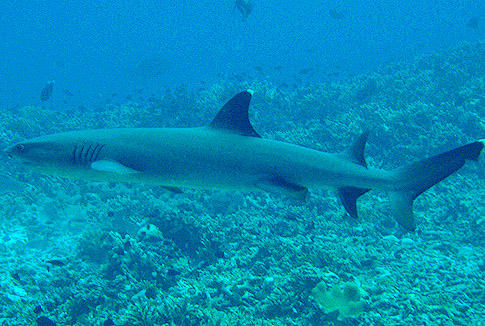
A white tip shark in Tubbataha

The Whitetip Reef Shark  (Triaenodon Obesusis ) is  one of the most frequent sharks in the Indo-Pacific.  This species is easily spotted due to its curious, irregular, and waving swimming style and of course, the white tip on its dorsal fins.  Sharks are not a common sight as you go down the  depths, their dwellings are likely in reefs  remote and undisturbed. My sightings were few and I feel blessed I had the opportunity for such encounters with them.

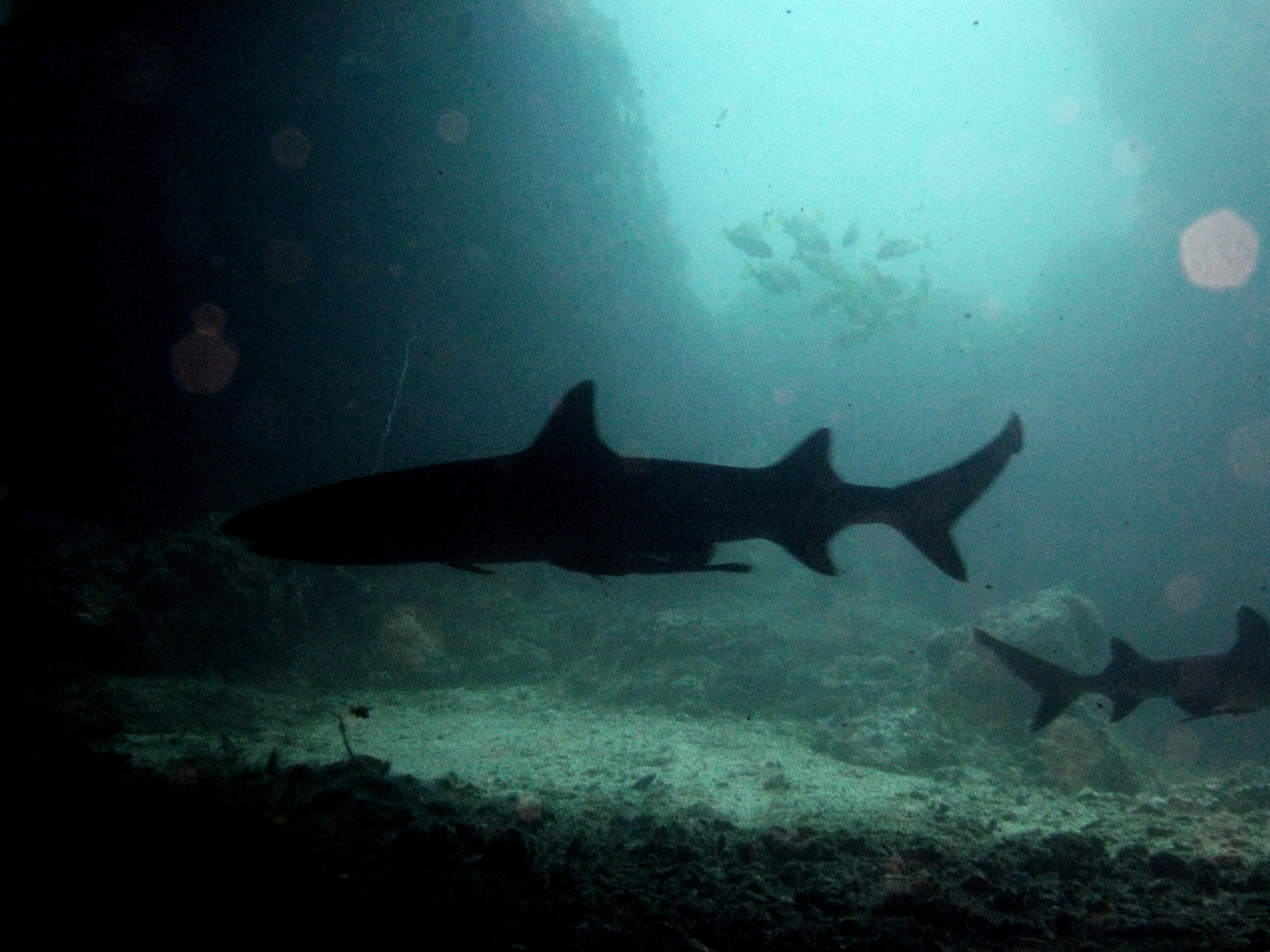
I found bunch of juvenile white tips in Apo Reefs in the shallows, astounding as it was.  Actually, it was magical!  And when we explored Tubbataha, we had a dose of it everyday.  It felt like it was ordinary tropical fishes wading everywhere, but still we kept our distance from them.  Lately, we had wonderful sighting of the species in a cave at Gato Island, Malapascua. It was incredible, we do not expect such wonderful scene.  But they were all there, swimming coyly all five of them in the dark, unsuspecting that five earthlings were watching them in the corners of the cave!  It was mesmerizing…
P1030972
White tips swimming coyly in a cave at Gato Island

Many people would cringe at mere mention of sharks being perceived as harmful. Yet sharks including white tips are interesting creatures which hardly would harm human beings unless threatened.  Here are few interesting  facts about Whitetips:

  1. This amazing fish is a very slim species.  At most, it grows to about 2.5 meters (8 feet) and weighs up to 20 kilograms (44 pounds). With its slender shape, grey complexion and pronounced gills, this creature of the sea is hard to miss.
  2. This species is found all across the Indo-Pacific region. It is found almost exclusively in coral reef habitats along the coral heads and ledges. Sometimes they can be seen near sandy flats, in lagoons, or near deep drop offs. The preferred depth is 8 to 40 meters (26 to 130ft) making this a shallow swimmer.
  3. Since this is a slow species compared to others, they prefer to hunt at night when most sea animals are sleeping. They prefer eels, crustaceans, octopus, lobsters, and crabs.
  4. The Whitetip Reef is a very social fish. They often lay on the ground in large groups. Many divers who see this phenomenon say it looks like a bunch of logs lined up side by side. This generally is not a territorial species, although they often spend many months in the same area.
  5. Since they are Viviparous, eggs are held in the placenta of the female fish until birth. Females are usually pursued by males for an extended period of time, at which point, the males will initiate contact by grasping the pectoral fin and maneuvering the two of them into proper position. Females give birth to 1 to 6 pups at a time and pregnancy lasts for 10 to 13 months.
  6. The Whitetip Reef Shark population has decreased over the years, even though they are toxic for human consumption. Due to their slow reproduction rate, late age maturity, and limited habitat, any human interference has large effects. So even though low levels of Whitetip Reef fishing are occurring, it is enough to dwindle the population and rate them as “Near Threatened”.
  7. Their threat to humans is minimal. This is a relatively harmless species but can spook swimmers and divers. They frequently swim close by to inspect swimmers but rarely pose any problems. Most bites occur from spear fishers getting bitten when the Whitetip Shark goes after their bait.
Amazing Cuttlefish

Cuttlefish
Cuttlefish is an interesting specie!

My last dive beneath the lowly Lapinig Island lead me to discover and know closely the elusive cuttlefish. This specie is so fast or was I so slow I never got glimpse of them in the wild, previous dives left me oblivious with only the dive guide or my dive buddy mentioning the sightings as we got to the surface.  The cold waters embraced me and while looking over the reef with hovering fishes, my dive guide caught my attention pointing beyond.  There over five meters from us was a footer cuttlefish observing us. I tried to inch my way to get closer, but it was backing away inch by inch too.  How magnificent!  It was swimming backwards, hovering near the soft corals – its fins around wiggling as if controlling its moves.  Its big sad eyes I presume looking at us, observing our moves too.  I lingered for a moment slowly trying to get near but it was moving back, maintaining its distance from me.  It was my first close encounter with a cuttlefish.

The amazing cuttlefish belongs to the class “cephalopoda”, the same family which octopus and squid belong to.  They are considered to have the highest intelligence of any invertebrate, as well as the ability to see backwards, use jet propulsion and keep buoyancy in the same way that submarines do. Oh, it shoots jets of ink as well!

Cuttlefish is now my new favorite, and before I’ll meet it again deep down I need to know more of this mysterious critter, I am sharing here few amazing facts of my new found friend:

10. Cuttlefish bone is filled with gas!

Cuttle-bone (the things you see in bird cages) has small chambers and like a submarine, filling or releasing the gas in them controls the cuttlefish’s buoyancy.

9. The flesh of the Flamboyant Cuttlefish is poisonous

This is the only species of cuttlefish known to have any poisons and it carries a unique toxin in its muscles. This species is also short and stubby, unlike the long graceful bodies of most others.

8. The cuttlefish eye is shaped like a W.

The unique shape of the pupils plays a part in the most highly developed eyes of any animal. They allow the cuttlefish to perceive light polarization and completely reshape their eyes to focus. They also really do have the proverbial eyes in the back of the head, with a second spot on the fovea which allows them to see backwards.

7. Cuttlefish can change color in mere seconds

Cuttlefish change color using a series of special skin cells, chromatophores, iridophores and leucophores, which reflect light in all sorts of colors.  It can change colors in seconds – that fast!

6. Cuttle fish can make themselves completely invisible

Not only do they reflect colors, they are able to merge almost completely with the seafloor.

5.Cuttlefish shoot jets of ink

Cuttlefish ink was the original sepia which was once used by artists – nowadays replaced mostly with synthetic sepia. The ink is used as a defense to confuse predators and allow the cuttlefish time to escape.

4. Cuttlefish don’t have a tail

They have a fin all the way around their body instead of tail fins, like squid, and they use this fin to control movement.

3. Cuttlefish have jet propulsion

Cuttlefish can escape from enemies by using rocket propulsion. Water is squeezed down their body (mantle) into a special tubular muscle (siphon) that controls the direction as they are propelled backwards for a short distance

2. Cuttlefish have green blood

Their blood is green because it uses the protein hemocyanin which has copper in it rather than hemoglobin.

1. Cuttlefish have 3 hearts

They have three separate hearts, one for each gill and and one for the rest of the body. One reason is that their blood flows more rapidly as hemocyanin contains much less oxygen than hemoglobin.

These amazing animals (cephalopods) are so unique and beautiful. Even submarines have made use of their buoyancy methods and they have physical characteristics that no other animal has, yet most of us only know them by the piece of cuttle-bone in a bird cage. Hopefully these facts have led you to admire them as much as I do.


NB. Unfortunately my point and shoot camera is incapable to take photo so I’m borrowing one  from   http://www.masseffect.wikia.com