"Now more than ever do I realize that I will never be content of a sedentary life on the surface, I will always be haunted by thoughts of being drenched elsewhere"….
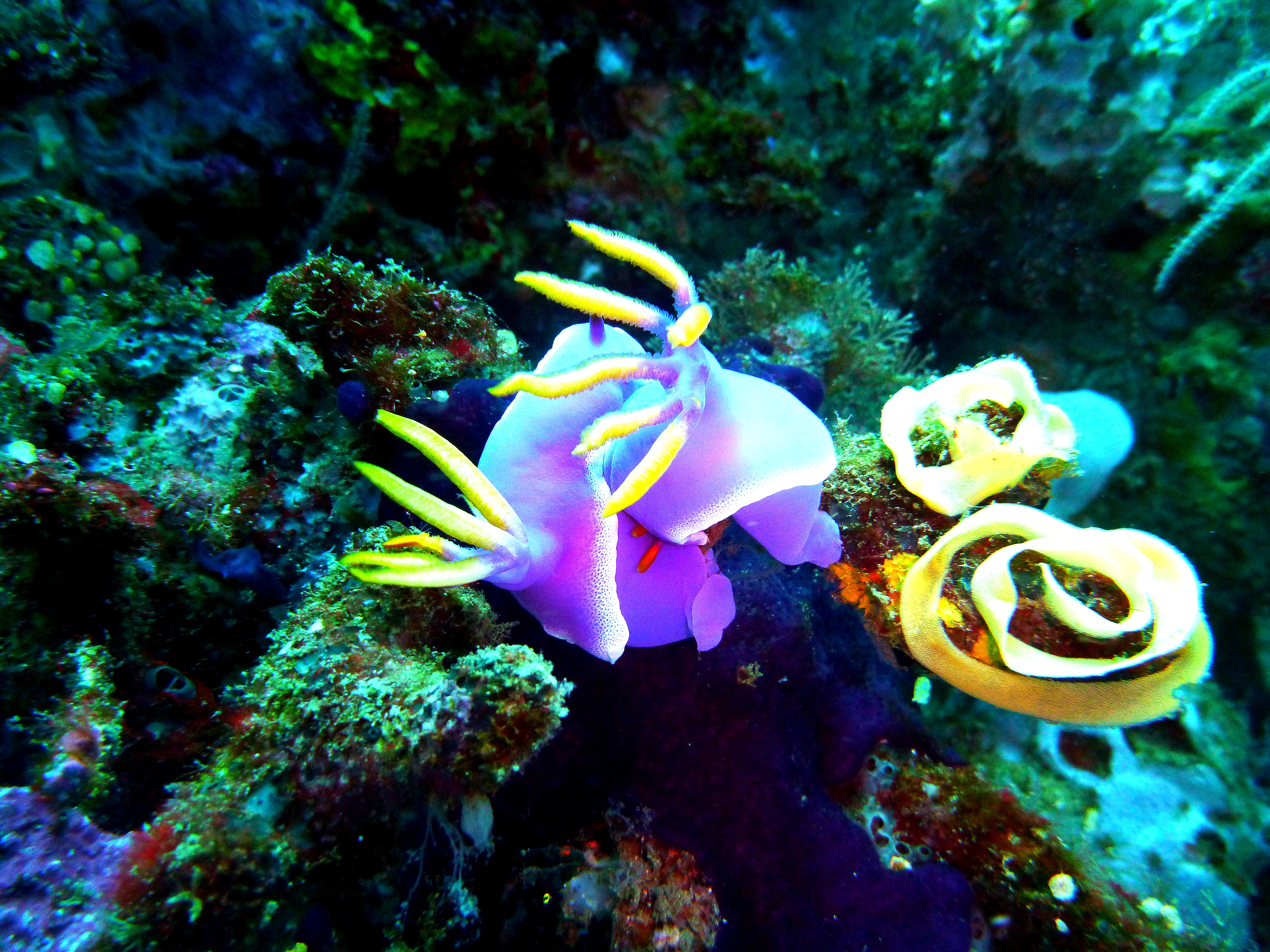
Just one of those rare moments while in depths, sighted randomly these colorful nudibranch on top of each other in Banaug Shoal, Mantangale
It’s one of those sea slug that catches one’s attention due to its striking appearance. The background color is a rich pinkish purple with a white border to the mantle. At the edge of the mantle the border is solid white but inside this is a region of varying width in which the white forms a reticulate pattern gradually merging in to the pinkish purple. The rhinophore stalks and the base of the gills is an intense purple, the rhinophore clubs and the gills are orange yellow.
It was mating season I guess, but that was the first time I witnessed this marine critter in such rare intimate moment! Hypselodoris apolegma is its binomial name, a specie of a dorid nudibranch.
Not in their “alone time”, this group of adults are probably hunting for food.
Barracudas are mainly famous and are labeled as deadly sea creatures. Recently, I had close encounter with a small school of them in the depths south of Panay Island. It was intriguing, as they didn’t quickly disappear from sight. Compared when I first saw them just few months when I become a certified diver. I watched in awe just few meters from me, the silvery group swimming coyly among themselves. It was a rare encounter!
These cold-blooded fish have not only swum the Earth’s oceans for the last 50 million years, they’ve also played a leading role in countless horror films. However, the barracuda doesn’t exactly live his life to terrorize swimmers; these scaly predators prefer to spend their days hunting fish, not humans!
Here are few facts on this dominant fish worthy to note:
• Barracudas vary in size, depending on the species. Largest species of barracuda can reach 6 feet in length and weigh up to 103 pounds.
• Upper part of the body is covered with scales that can be black, brown, grey or blue in color. Belly is always white. Irregular dark spots are located on both sides of the body.
• Barracuda has elongated body with pointed head. It has two dorsal fins and tail fin shaped like a fork.
• Barracuda has very sharp, dagger-like teeth which prevent slipping of the prey from the mouth.
• Barracuda’s diet consists of different types of fish: groupers, anchovies, mullets, snappers… Besides fish, barracuda sometimes eats squids and crustaceans.
• Shiny objects attract barracuda’s attention. Because of that, barracuda usually hunts fish with golden or silver scales.
• Barracuda is known as dangerous fish that can attack divers without any obvious reason.
• Barracuda can act as an ambush predator that attacks using the factor of surprise. When there is no place to hide, barracuda will chase its prey actively.
• Barracuda is nocturnal animal (active during the night).
• Barracuda can swim at the speed of 25 miles per hour. This feature is useful both for hunting and for escape from predators.
• Even though barracuda is one of the greatest predators in the sea, it can be prey of some large marine animals. Biggest enemies of barracuda are killer whales and sharks.
• Barracuda prefers solitary life, but it sometimes gathers in groups called “schools”. Life in a group provides safety and facilitates hunting (group of barracuda hunts cooperatively).
• Mating season of barracudas takes place in the spring. Males and females release eggs and sperm cells in the water where they will combine to form fertilized eggs. Females produce and release more than 1000 eggs but only few eggs will manage to survive until the adulthood.
• Barracuda’s age can be determined by counting the rings on the scales and on the otolith (structure in the inner ear). Number of rings matches the age of the fish.
• Barracuda can survive from 10 to 15 years in the wild.
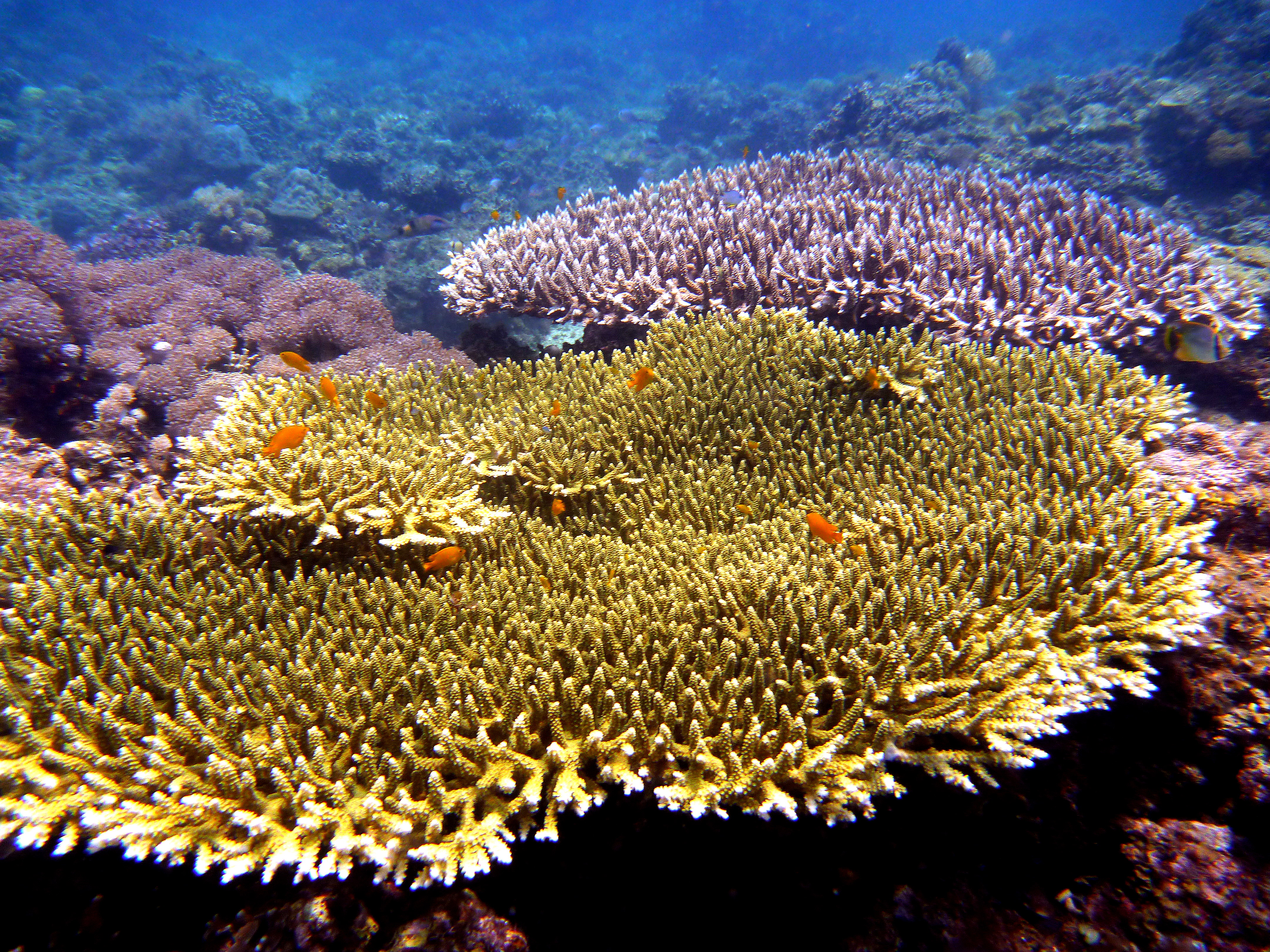
These colorful table corals were spotted in the depths of Punta Gorda, San Agustin in Tablas Island
The above specie is knowns as table coral which belong to the genus Acropora, some called them as elkhorn or staghorn coral. Acropora species are one of the major reef corals responsible for building the immense calcium carbonate substructure that supports the thin living skin of a reef. Acropora is most common in shallow reef environments with bright light and moderate to high water motion. Many small reef fishes live near their colonies and retreat into the thicket of branches if threatened.
They can come in different colors, such wonderful to behold while underwater! More often they are decorated with colorful fishes hovering over them, mostly claiming as their shelter and abode.
Definitely my madness of Moalboal is unrelenting, it seems I never get enough of its underwater show. For the nth time, I declare that the sardines’ phenomenon is grand spectacle and literally an iconic one. The mammoth shoal is my overriding reason for coming again and again to Moalboal, and I will never get tired of watching in awe while underwater. It is the only dive site in Southeast Asia that is home to a school of fish so immense, it provides a rare and iconic backdrop of shimmers, shadows and amazing shapes. I was in for a show as I float at fifteen meters watching above me. So stunning!
We went again for the 4th time to experience once its majestic display last June, and mutually agreed for another return for this same reason. Moalboal is a must visit site in the Philippines and if you are after this majestic display of humongous school of sardines, don’t wait long for a trip to this southern town in Cebu. Experience this underwater Shoaltime!
Ctenoides ales, known to scuba divers as the “electric clam” or “disco clam”, is a species of saltwater clam, a marine bivalve mollusk in the family Limidae, the file clams. The clam has been given these nicknames because its soft tissues flash light like a disco ball.
Studies revealed that it is not a bioluminescence phenomenon, but is instead coming from reflection of the ambient light, either the sun or diving light. It was my second sighting when we dive in Moalboal last June, a rare specie I didn’t encounter them in any other dive sites we visited so far.



 Life in the Great Beyond
You must be logged in to post a comment.