Two in One

P1040893
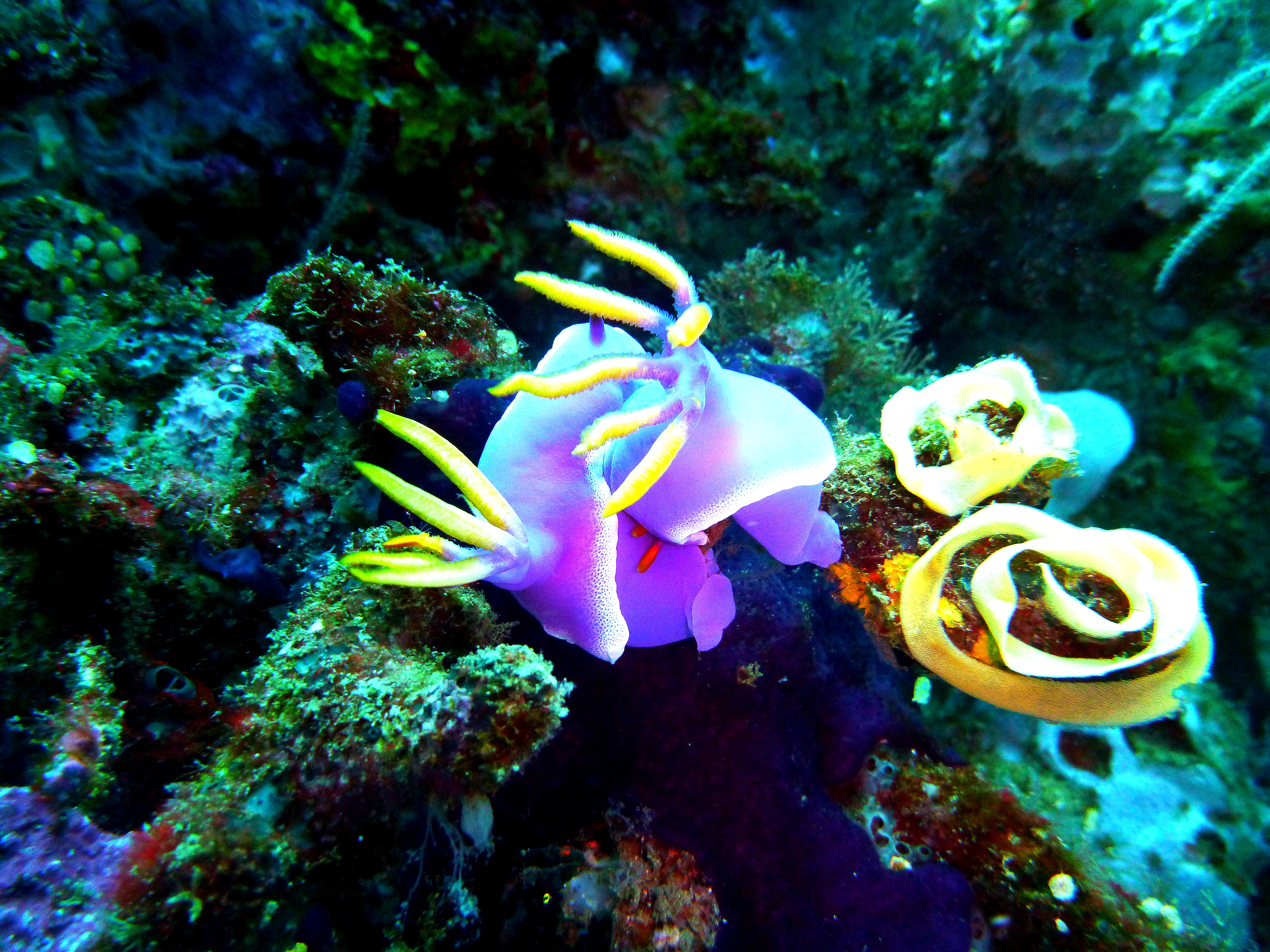
Just one of those rare moments while in depths, sighted randomly these colorful nudibranch on top of each other in Banaug Shoal, Mantangale

It’s one of those sea slug that catches one’s attention due to its striking appearance. The background color is a rich pinkish purple with a white border to the mantle. At the edge of the mantle the border is solid white but inside this is a region of varying width in which the white forms a reticulate pattern gradually merging in to the pinkish purple. The rhinophore stalks and the base of the gills is an intense purple, the rhinophore clubs and the gills are orange yellow.

It was mating season I guess, but that was the first time I witnessed this marine critter in such rare intimate moment!  Hypselodoris apolegma is its binomial name, a specie of a dorid nudibranch.

Few Facts on Barracudas

barracudas2
Not in their “alone time”, this group of adults are probably hunting for food.

Barracudas are mainly famous and are labeled as deadly sea creatures.  Recently, I had close encounter with a small school of them in the depths south of Panay Island. It was intriguing, as they didn’t quickly disappear from sight.  Compared when I first saw them just few months when I become a certified diver.  I watched in awe just few meters from me, the silvery group swimming coyly among themselves. It was a rare encounter!

These cold-blooded fish have not only swum the Earth’s oceans for the last 50 million years, they’ve also played a leading role in countless horror films. However, the barracuda doesn’t exactly live his life to terrorize swimmers; these scaly predators prefer to spend their days hunting fish, not humans!

Here are few facts on this dominant fish worthy to note:

• Barracudas vary in size, depending on the species. Largest species of barracuda can reach 6 feet in length and weigh up to 103 pounds.
• Upper part of the body is covered with scales that can be black, brown, grey or blue in color. Belly is always white. Irregular dark spots are located on both sides of the body.
• Barracuda has elongated body with pointed head. It has two dorsal fins and tail fin shaped like a fork.
• Barracuda has very sharp, dagger-like teeth which prevent slipping of the prey from the mouth.
• Barracuda’s diet consists of different types of fish: groupers, anchovies, mullets, snappers… Besides fish, barracuda sometimes eats squids and crustaceans.
• Shiny objects attract barracuda’s attention. Because of that, barracuda usually hunts fish with golden or silver scales.
• Barracuda is known as dangerous fish that can attack divers without any obvious reason.
• Barracuda can act as an ambush predator that attacks using the factor of surprise. When there is no place to hide, barracuda will chase its prey actively.
• Barracuda is nocturnal animal (active during the night).
• Barracuda can swim at the speed of 25 miles per hour. This feature is useful both for hunting and for escape from predators.
• Even though barracuda is one of the greatest predators in the sea, it can be prey of some large marine animals. Biggest enemies of barracuda are killer whales and sharks.
• Barracuda prefers solitary life, but it sometimes gathers in groups called “schools”. Life in a group provides safety and facilitates hunting (group of barracuda hunts cooperatively).
• Mating season of barracudas takes place in the spring. Males and females release eggs and sperm cells in the water where they will combine to form fertilized eggs. Females produce and release more than 1000 eggs but only few eggs will manage to survive until the adulthood.
• Barracuda’s age can be determined by counting the rings on the scales and on the otolith (structure in the inner ear). Number of rings matches the age of the fish.
• Barracuda can survive from 10 to 15 years in the wild.

NB.  The above interesting facts were taken from http://www.softschools.com
Photo credits to http://www.periodistapesca.blogspot.com

Deep in Anini-y!

Sometimes we need to go somewhere, be it on surface or depths,  just to be alone.

Coming to this lowly quiet town in Western Visayas was one of those quirky option after getting low cost airfare to Iloilo, its been some time since I last visited this heritage city.  And being one of my favorite cities, coming again after a long lull was such pure bliss, much more for the depths! I just missed the randomness of going alone on the road.

It is far, secluded, bucolic, lowly and unexploited and in a deeper way held so much attraction to me. It is not in the diving map, diving trips in Panay is unheard of (except the expensive, touristy Boracay) at least for me. Despite challenges again, I arrived late (about 9pm) at the dive resort with my hosts eagerly waiting for me. Leaving home early to catch flight, I was more than twelve hours on the road. The desire was just too great for this surreptitious spell, my gills are utterly dry and my fins itching. The aborted dive plan in Zamboanga needs remedial compensation.

Complicated but not Hard

My DM was no less than the owner of The Divehouse, the initial plan was do an early first dive together with other two divers, but I end up alone with my DM separated from the others. I searched DM AJ’s eyes for an explanation.

“Complicated?” I echoed my answer in wonder. He smiled assuring it’s not a hard dive but somewhat complicated for the newbies, referring to other guests who were just certified recently. So we cruised going west off the town coast, catching a glimpse of the old town church partly hidden from trees. The captain dropped anchors after thirty minutes guided by GPS.

Our first descent was a site they called Mamam which was briefly described by DM AJ as with white sands, rock mounds, swim-throughs and good marine life. I jumped in to follow my DM about two minutes later. Only to find out later he was just checking if we got the right spot, but it was not so we need to abort as he signaled for up!

We made it in our second attempt, we found the shoal as we went deep at 30 meters. It was a small colony of diverse marine life: variety of tropical fish – moorish idol, damsels, midnight snappers, triggerfish, groupers, parrots, sea whips, sponge baskets, sea cucumber, variety of soft corals and more. The highlight of it was the resident school of barracudas – which I found intriguing. They didn’t quickly disappear but swam calmly away, but my DM led me to get an obstructed view behind tangles of whips and soft corals. Watching them swimming coyly among themselves as if relaxing was a wonderful sight, felt like I was in company with them in their abode! We ascend after 45 minutes with my air at 1200 psi, 33.4 meters as our deepest.

I had a long relaxing surface interval – late breakfast alone and long wait for the team with two boatful of other guests who went to Nogas Island. Cruising westward again for my last dive with DM Boy, my mind was racing for more surprises deep down expecting another rich encounter as in the first. They called the site Bao-bao, another unspoiled colony and a deep dive again. We descend through the anchor line slowly mindful of the afternoon current, and indeed it was another display of active and varied marine life. There were surgeons, butterfly, snappers, groupers, angels, banners, breams, anthias, sand perch, unicorns, sponges, soft and hard corals and more. I was amazed of the richness down the flat blue waters, somewhere down it held important dwellings of delicate and precious marine species. The highlight of which is the giant moray eel, it’s head big as coffee cup! I did spend moments just watching the eel in awe, I swear it was the biggest moray I have encountered. I went 32.5 meters as deepest after 45 minutes with 1200psi of air left.  Both dives were in enriched air at 32%.

Treasures Captured

Discovering Anini-y in the depths was a real surprise, a revelation of the richness from this sleepy town in down south of Panay. Sometimes there are events that are just meant to be despite the challenges. There are people that comes our way who become instruments and inspiration for those important moments. The delayed flight, road traffic, late arrival for the transpo, costly taxi trip to the town, costly accommodation – it paid off without doubt! What I witnessed could never be put exactly in this account, it was another priceless encounter and treasures in my heart to keep.

Nogas Island, Anini-y  Church, Siraan Hot Spring.  Just few of reasons to be back in this town’s bosom.  Most importantly, my gills and fins shall ache for its paradise beyond the surface.  Alone, away, somewhere is always a rewarding one. I don’t doubt it anymore.

Travel Notes

1. The town of Anini-y is 81 kilometers from Iloilo City about two hours by land and can be reached by bus or van from Molo terminal.
2. The only diveshop in town is The Divehouse owned and operated by Mr. Boy Saldana with his friendly DMs – AJ and Mike.
3.  Diving in nitrox is available at the Divehouse.

NB. Photo credits to http://www.divehouse.com

Tables in the Depths

P1040577
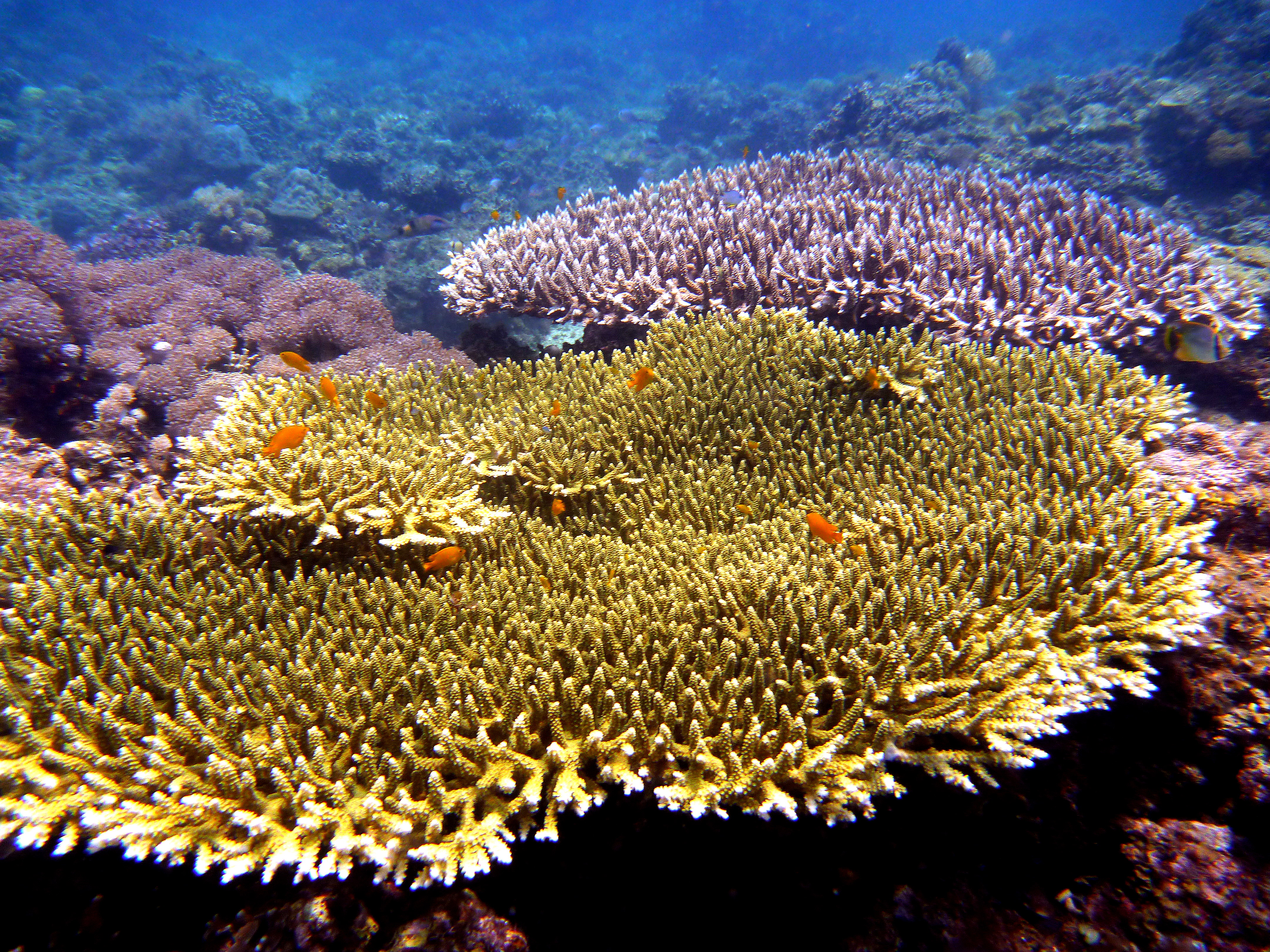
These colorful table corals were spotted in the depths of Punta Gorda, San Agustin in Tablas Island

The above specie is knowns as table coral which belong to the genus Acropora, some called them as elkhorn or staghorn coral.  Acropora species are one of the major reef corals responsible for building the immense calcium carbonate substructure that supports the thin living skin of a reef.  Acropora is most common in shallow reef environments with bright light and moderate to high water motion. Many small reef fishes live near their colonies and retreat into the thicket of branches if threatened.

They can come in different colors, such wonderful to behold while underwater!  More often they are decorated with  colorful fishes hovering over them, mostly claiming as their shelter and abode.

Preventing the Bends

Diving can be one of life’s most special and enjoyable activity, personally it is my strategy in maintaining my equilibrium. I treasure my underwater moments and discoveries – there is always joy in diving. Admittedly though, there are risks and we all knew this since the early days when we took our first lessons in diving. The ever present possibility of decompression sickness (DCS) is always on the lookout. DCS or the bends is a big turn-off for others, indeed it is not for the faint hearted.

diving emergencies

Of course, the bends can be avoided as we all learned, by following the guidelines and using our common sense. Here are few rules I lifted from Dive Medic written by Steve Muscat in Asian Diver:

1. If you have extra air left, why not do more deco than required, even if your computer says you don’t need it, especially if you are enjoying it. Computers give you the minimum stop required, but if you want to be really safe, you can do a really long, shallow stop.

2. The second common cause of DCS today is deep double dives with too short a surface interval. This is present in places with multiple or large wrecks in deeper water, because divers dive more than once at the same site. Contrary to what one finds in the literature, inner ear DCS has become much common in sport diving. Reverse profile diving is commonly associated with more hits. So, if you are doing a 15 meters and a 40 meters dive, the deep one should be the first. Also, if diving repeatedly all week, slot in a day off to avoid accumulation of nitrogen.

3. In warm climates, hydration is always a problem. Divers notoriously don’t drink enough before a dive and after a dive. Drinking alcohol before a dive increases dehydration, even if it is only a couple of beers the night before.

4. Diving with any form of illness or infection will also contribute to a hit. Signs of an infection is commonly found on a DCS patient even if they are feeling fine.

5. Acclimatisation is also another factor. Like climbing a mountain, one needs to build up to a deep dive. Some divers get a hit from a dive they commonly do, just because they had not dived for some months. Age is another consideration. When diving remote places do not push profiles just because you have done the dive before 30 years ago! It is also a well-documented fact that divers should avoid strenuous exercise before and after a dive as this can increase the chance of DCS.

Finally, many cases of undeserved DCS are seen. The scenario is usually a tourist who has taken on two consecutive dives deemed safe on computer but end up with a skin or inner ear DCS. A lot of these are found to have a PFO2 on investigation. So again if diving off grid, keep a safer profile than the usual.

There are obviously other factors involved in DCS causation. But if one follows the simple rules with common sense, DCS will be one less worry.

Diving is one sport where mindfulness and cautiousness is necessary, while one may  be too comfortable based on long experience, Yet following the basics one can never go wrong.

Here are list of Recompression Chambers in the Philippines in case of emergency:

Batangas City

Batangas Hyperbaric and Wound Healing Center
St. Patrick’s Hospital Medical Center
Lopez Jaena St. Batangas City 4200
Batangas, Philippines
Tel. +63-43-723-8388 Fax. +63-43-723-1606
Beeper: 150-611-169
Email: mperezmd@pworld.net.ph , mperezmd@batangas.net.ph

Cavite City

Sangley Recompression Chamber
NSWG, Philippine Fleet
Naval Base Cavite
Sangley Point, Cavite City, Philippines
Contact Person: Capt. Pablo Acacio
Phone: +63 (46) 524-2061 local 4191 / 4193

Makati City

DAN (Divers Alert Network) SE Asia Pacific:
Suite 123, Makati Medical Center,
2 Amorsolo St., Makati City 1200
Tel. No. (632) 817-5601
Contact Person: Dr. Benjamin Luna M.D.

Quezon City

AFP Medical Center – Recompression Chamber
V. Luna Road, Quezon City, Philippines
Contact Person: Jojo Bernardo, M.D., Fred C. Martinez
Phone: +63 (2) 920-7183
Phone: +63 (2) 426-2701 local 8991 / 6445

Subic

Subic Recompression Chamber
Subic Bay Freeport Zone,
SBMA, Olongapo City, Philippines
Contact Person: Randy Delara, Lito Roque
Phone: +63 (47) 252-7566
Phone: +63 (47) 252-7052, 252-5211 (evening)

Cebu

Cebu Recompression Chamber
Viscom Station Hospital
Military Camp Lapu-Lapu
Lahug, Cebu City, Philippines
Contact Person: Mamerto Ortega, Mamerto Ortega
Phone: +63 (32) 310-709 Chamber
Phone: +63 (32) 232-2464 to 68 local 3625 / 233-9942

Roving Chamber

Philippine Coast Guard Action Center
Roving Vessel Chamber
Tel. No. (632) 527-3880

M/S BRP EDSA II 002
M/S BRP SAN JUAN 001 (Based in Cebu)

NB. Photo credits to http://www.thescubadivingdirectory.com