Few Facts on Sharks

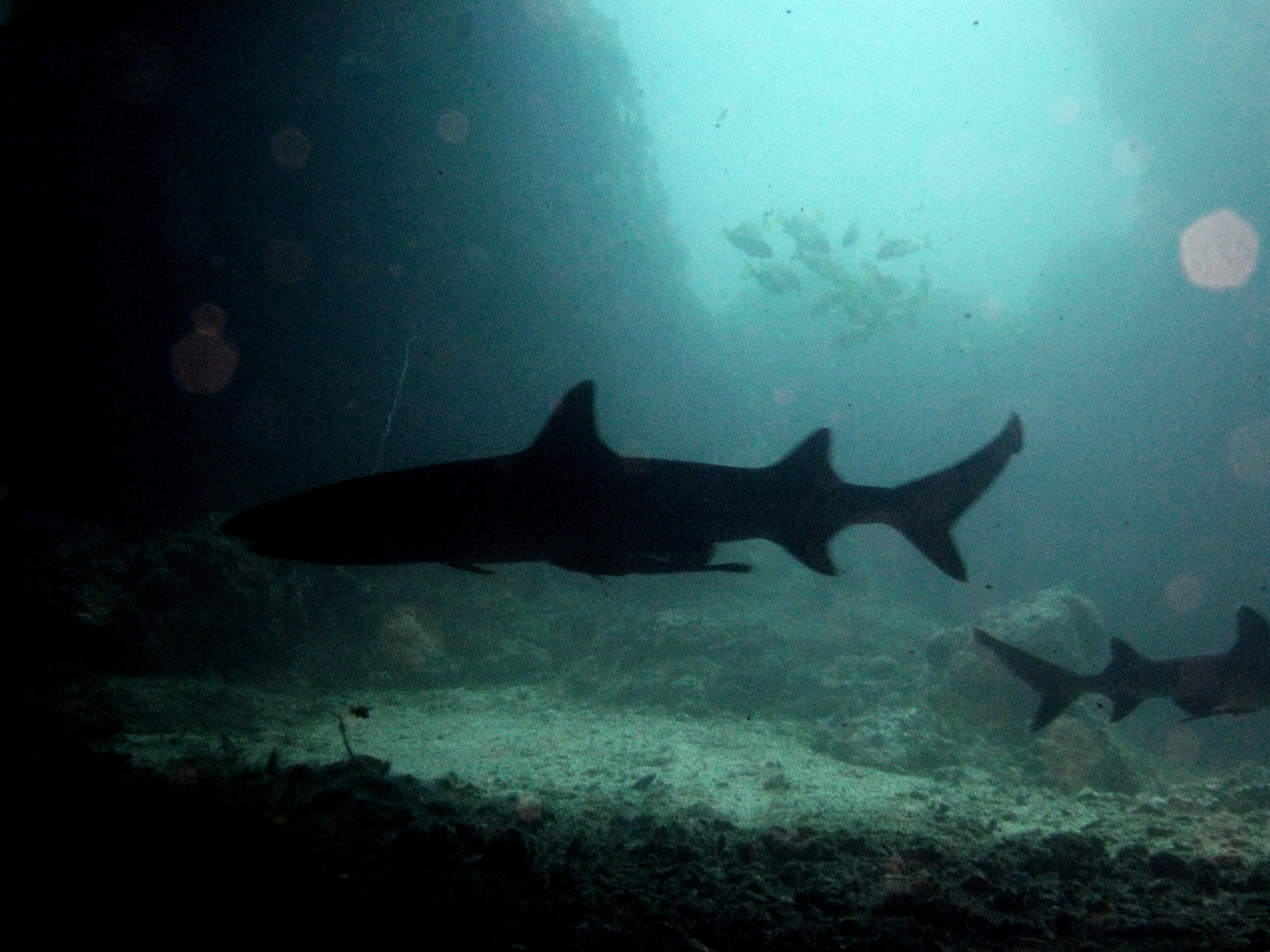
Reef sharks in a cavern in Gato island, Malapascua
Reef sharks in a cavern in Gato Island, Malapascua

In celebration of Shark Week, which was originally developed to raise awareness and respect for sharks, it would be interesting to know few facts about this often misunderstood species.. Hopefully, this will gain more understanding of this amazing marine creatures.

1. Sharks move like airplanes. They create forward movement with their tails (like propellers) and water moves over their fins like wings

2. Different sharks have different etiquette for feeding. Caribbean reef sharks, for example, have a pecking order catering to large sharks 1st

3. Certain shark species (such as great white) will drown if they stop moving. They lack necessary muscles to pump water through their mouth

4. Blue sharks are piggy eaters. They’ll keep eating until they regurgitate, after which they go back to eating!

5. 20% of sharks are close to extinction because of commercial fisheries accidentally catching sharks with their hooks and nets

6. Researchers have discovered common objects (tires, gasoline tanks, and license plates) left intact inside the stomachs of tiger sharks

7. Hammerhead sharks’ oddly shaped heads, called cephalofoils, are equipped with electrical sensors, making them superior hunters

8. Sharks aren’t color blind. Divers have claimed that sharks are attracted to certain colors, such as the “yummy yellow” of some wetsuits

9. Almost 50 different shark species have light-emitting organs called photospheres. Sharks use their light for camouflage and to attract mates

10. A shark’s size relates to where it hunts: smaller sharks feed near the ocean floor, while larger sharks hunt in the middle ocean depths

11. When the USS Indianapolis was attacked by a shark during World War II, 900 sailors were stranded in the Philippine Sea near Guam for 4 days

12. While more likely to die from drowning, surfers can succumb to shark attacks because of their boards, which to great whites resemble seals

13. Shark fin soup is a delicacy in China and is served at important events like weddings and anniversaries. The dried fins resemble noodles

14. You can’t see a shark’s ears, but their inner ears can track sounds of their prey from lengths of more than 800 feet (244 meters)

15. Sharks are susceptible to the moon’s control of ocean tides. Moon phases affect sharks’ eating habits and draw them closer to shore

16. Sharks have an astounding sense of smell, so powerful that they can detect a single drop of blood in an Olympic-sized pool

17. Signs that a circling shark will attack: it will hunch its back, lower its pectoral fins (fins near its belly) and swim in zigzag motions

18. Even though sharks have razor-sharp teeth, they don’t use them for chewing prey. They are for ripping; resulting chunks are swallowed whole

19. Punching a shark in the nose or poking its eyes can help to fend it off during an attack. Most sharks don’t want to work hard for their food

20. While many of us have learned to fear sharks, they are the ones who should fear us. Humans kill 73 million sharks annually

NB. Photo courtesy of my dive buddy Angel during our dive at Gato Island

Blue Spotted Stingray

Blue spotted stingray are bottom dwellers frequently on sandy area

The bluespotted stingray (Neotrygon kuhlii) or Kuhl’s stingray, is a species of stingray of the Dasyatidae family. It is light green with blue spots. Its disk width hovers around 42 centimeters (17 in). It is popular in aquaria but usually not distinguished from the bluespotted ribbontail ray. The ribbontail is rounder with brighter blue and more vivid spots, but the bluespotted stingray is larger.[1] The stingray’s maximum age estimate is from one to eighteen years of age. The bluespotted stingray preys on many fish and small mollusks, but is also preyed on by the killer whale and hammer head shark.[2] The bluespotted stingray is also generally found in Indonesia to Japan, and south to Northern Australia. The bluespotted stingray is also targeted by many parasites such as tapeworms, flatworms, and flukes.

Our second and third dive in Bacuit Bay last June was graced by these interesting species and what a joy, it was my first up-close encounter with them.  One was camouflaging on the white sands. Our DM poked it and it just hopped few steps from us, obviously not disturbed by our presence. Its disk gracefully flapped and landed peacefully on the sands again.  The myth was that they can whip with their powerful tails with poison.  But it appeared friendly and calmly resting, though not playful.

I relaized that Entalula Island and Twin Rocks are identified sanctuaries of stingrays, perhaps if I got the chance to dive again at El Nido in the future, I could chance upon a herd of them lining up with their pups. Then I could swim with them side by side while they flap gracefully.  Just like Stingray City in the Grand Cayman!

NB. Photo credits to http://www.flmnh.ufl.edu

White Tips Galore

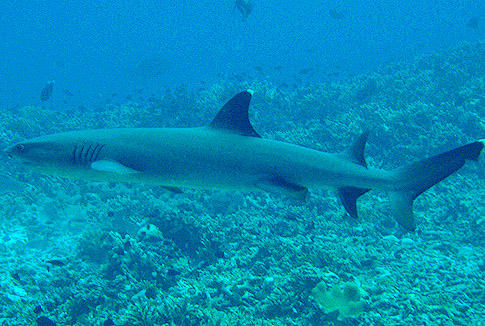
A white tip shark in Tubbataha

The Whitetip Reef Shark  (Triaenodon Obesusis ) is  one of the most frequent sharks in the Indo-Pacific.  This species is easily spotted due to its curious, irregular, and waving swimming style and of course, the white tip on its dorsal fins.  Sharks are not a common sight as you go down the  depths, their dwellings are likely in reefs  remote and undisturbed. My sightings were few and I feel blessed I had the opportunity for such encounters with them.

I found bunch of juvenile white tips in Apo Reefs in the shallows, astounding as it was.  Actually, it was magical!  And when we explored Tubbataha, we had a dose of it everyday.  It felt like it was ordinary tropical fishes wading everywhere, but still we kept our distance from them.  Lately, we had wonderful sighting of the species in a cave at Gato Island, Malapascua. It was incredible, we do not expect such wonderful scene.  But they were all there, swimming coyly all five of them in the dark, unsuspecting that five earthlings were watching them in the corners of the cave!  It was mesmerizing…

P1030972
White tips swimming coyly in a cave at Gato Island

Many people would cringe at mere mention of sharks being perceived as harmful. Yet sharks including white tips are interesting creatures which hardly would harm human beings unless threatened.  Here are few interesting  facts about Whitetips:

  1. This amazing fish is a very slim species.  At most, it grows to about 2.5 meters (8 feet) and weighs up to 20 kilograms (44 pounds). With its slender shape, grey complexion and pronounced gills, this creature of the sea is hard to miss.
  2. This species is found all across the Indo-Pacific region. It is found almost exclusively in coral reef habitats along the coral heads and ledges. Sometimes they can be seen near sandy flats, in lagoons, or near deep drop offs. The preferred depth is 8 to 40 meters (26 to 130ft) making this a shallow swimmer.
  3. Since this is a slow species compared to others, they prefer to hunt at night when most sea animals are sleeping. They prefer eels, crustaceans, octopus, lobsters, and crabs.
  4. The Whitetip Reef is a very social fish. They often lay on the ground in large groups. Many divers who see this phenomenon say it looks like a bunch of logs lined up side by side. This generally is not a territorial species, although they often spend many months in the same area.
  5. Since they are Viviparous, eggs are held in the placenta of the female fish until birth. Females are usually pursued by males for an extended period of time, at which point, the males will initiate contact by grasping the pectoral fin and maneuvering the two of them into proper position. Females give birth to 1 to 6 pups at a time and pregnancy lasts for 10 to 13 months.
  6. The Whitetip Reef Shark population has decreased over the years, even though they are toxic for human consumption. Due to their slow reproduction rate, late age maturity, and limited habitat, any human interference has large effects. So even though low levels of Whitetip Reef fishing are occurring, it is enough to dwindle the population and rate them as “Near Threatened”.
  7. Their threat to humans is minimal. This is a relatively harmless species but can spook swimmers and divers. They frequently swim close by to inspect swimmers but rarely pose any problems. Most bites occur from spear fishers getting bitten when the Whitetip Shark goes after their bait.