Photography in Marine Environment

The marine world is in-arguably amazing and is filled of many wonderful specie, again and again a lot of us desired to take all the memories in photos.  It is understandable, you might not encounter this interesting animal next time and if you might, who knows when.  The present world is becoming photo obsessed and many including us divers are influenced with this social media trending.  However, we all have this important responsibility in preserving this beloved vast blue beyond. Photography under water if not judicious is undoubtedly a real threat to marine life.

Here are few do’s and dont’s while shooting that avant-garde photos in the blue beyond:

  1.  Do have good look around while resting on the bottom. Even its only sand, you might about to crush nudis or seahorse.
  2. Do capture behavior by knowing your subject, reading books and studying marine life.
  3. Do make sure your camera/housing is neutrally buoyant. There are plenty of float arms available in the market. This can help also if you accidentally drop your equipment.
  4. Do secure all dangling equipment, streamlining is the key as we have been taught from the start.
  5. Do use common sense when choosing subjects to shoot at night.
  6. Do place the welfare of plants and animals and the care of the environment over the need to get any shot
  7. Don’t even think of taking a camera underwater if you are a novice diver. Wait until you get the advance course and maybe 50+ dives! 🙂
  8. Don’t insist on taking pictures if the subject is inaccessible.
  9. Don’t add unnecessary stress to an animal who is already stressed. Be discerning in using flash, it can’t be denied that constant flash is taking toll on any subject.
  10. Don’t harass animals on night dives, avoid flashing directly your torch on them.
  11. Don’t feed the fish! This is very basic….
  12. Don’t force animals into behavior just to get a shot. Again, don’t touch any fish for that yawn effect. Such gesture is actually telling you to go away. So be sensitive!

In my diving novitiate years, I prefer having no camera at all because I can observe marine life better and I have other more important issues to attend to like the basics and protocols. Diving is simpler with less accessories. My first point-shoot camera came two years later when I felt I was ready for such task underwater. It’s true, nothing beats having photos of amazing finds underwater. But after it was flooded, I got my second point-shoot camera a year later with no rush, which I’m using until now. It was serving its purpose I guess, I got decent photos for my write-ups and I  am happy with it.  The point is, the welfare of the marine world is important than the fleeting desire to get photos. 🙂

The truth,  marine world would be perfectly thriving and safer without the photos!

NB.  Adapted from Asian Diver Mag, Colors of Asia Edition

Batfish

p1060204

 Platax teira is common in Philippines waters

This is one the species most typically associated with the description of ‘batfish’. Also belonging to the Ephippidae family, the Platax tiera (or longfin batfish) can be found across the Indo-Pacific region, often enjoying the surroundings of shipwrecks, floating seaweed, anchored boats and mooring ropes.  Juveniles don’t look much like their adult counterparts, but are masters of mimicry, pretending to be leaves or even flatworms to hide from predators. Platax tiera are omnivores, eating algae as well as invertebrates, plankton, corals and anemones. They are curious fish, often schooling with other species and approaching divers to present a fantastic photo opportunity.

Yes, we found this specie in Coron wrecks, they came near as if asking for food and followed us just like a pup. Our latest dive gave me an opportunity to interact again with this curious fish. As soon as we deflated our BCs, they were there swimming coyly as if waiting for us.  As we navigated around, another batfish followed us all the way through until we had our safety stop. It was our company silently watching us, so amusing!

The above photo was taken at Olango Island, Cebu

Salpa Maggiore!

It was a rare encounter while we were diving in Sumilon Island in Oslob, Cebu. It happened quick as I have seen something transluscent floating towards me. Watching and wondering what it was, I managed to snapped few photos.  Almost tempted to touch the specie, I changed my mind thinking it might some kind of poisonous.

Searching some materials revealed this mysterious creature. Salps may look similar to jellyfish, but they are more closely related to marine vertebrates including fish.

Although they are mainly transparent, the bizarre creatures have gills and a heart. Like other tunicates, their bodies are encased in a sac-like structure, which has an opening at each end. As water pumps in and out of the openings, or siphons, Salps are propelled through the water. Filters inside their body sift through the water and collect their food, which consists mainly of algae and phytoplankton.

As reported by Plankton Chronicles, Salpa maggiore can grow to around 10 inches long and often travel in large groups, or chains. As they are asexual, the creatures are capable of producing their own offspring to form the massive chains. While part of a chain, salps use electrical currents to communicate and synchronize their movements.
Read more at http://www.inquisitr.com/1104937/salpa-maggiore-mysterious-translucent-fish-identified/#wtSSJjslXOOHrOD9.99

It was surprising to find one in waters of southern Cebu as they are commonly found in cooler waters of the Southern Ocean. It was my first time to find one after diving some time in the Philippine waters.

Have you find this specie whilst diving or snorkeling?

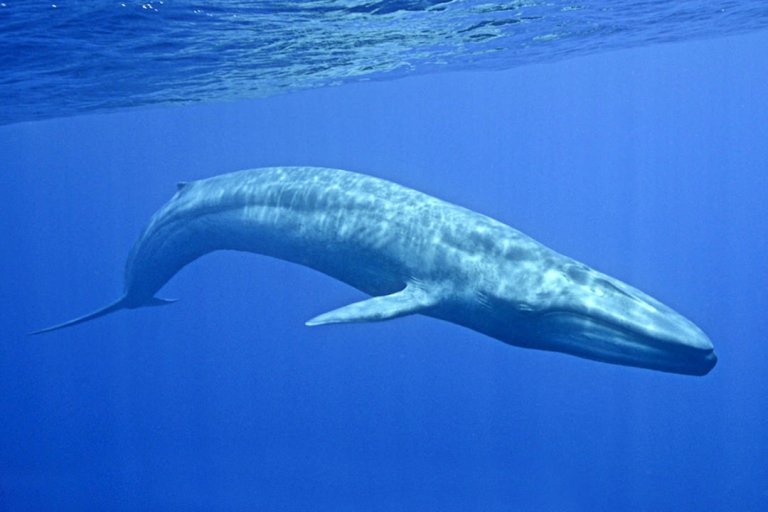
THE BLUE WHALE

blue_whale
Photo courtesy of http://www.biganimals.com

QUICK FACTS

The Blue Whale (Balaenoptera musculus)is the largest animal that ever lived on Earth. They can grow to 30 meters, weigh up to 181 metric tons and live 80-90 years.

Status:

Endangered (World Conservation Union Red List) due to rampant whaling in the 1960s.

They feed mostly on krill (tiny shrimp like animals) and can consumer around 3.6 metric tons in a day.

They belong to the baleen whales. Baleens are fringed plates of fingernail-like material attached to their upper jaws.  They feed by swallowing mouthful of water and expelling these through the baleen which acts as filter that trap the krill.

Blue whales are graceful swimmers and cruise the ocean at more than eight kilometer per hour, but accelerate to more than 32 kilometers an hour when they are agitated.

Blue whales are among the loudest animals on the planet. They emit a series of pulses, groans, and moans and it is thought that, in good conditions, blue whales can hear each other up to 1,000 miles (1,600 kilometers) away.

THEY ARE ENDANGERED

Their huge size does not spare them from human threats.

They are threatened by boat collision. Dynamite fishing, marine debris entanglement, plastic trash pollution, chemical and sound pollution.

WHAT YOU CAN DO TO HELP SAVE THEM

Help spread awareness about conserving and protecting our marine resources.

Report illegal fishing activities.

Reduce your plastic waste.

Help document presence of whales and other large marine life (do this from a safe distance).

Hotlines:

Maritime Police                               0927 893 4993
Coastguard (Dumaguete City)     0915 112 8823; 0929 674 2380
BFAR                                                    0926 357 2278
DENR                                                   0905 595 9149

A campaign of Marine Wildlife Watch of the Philippines

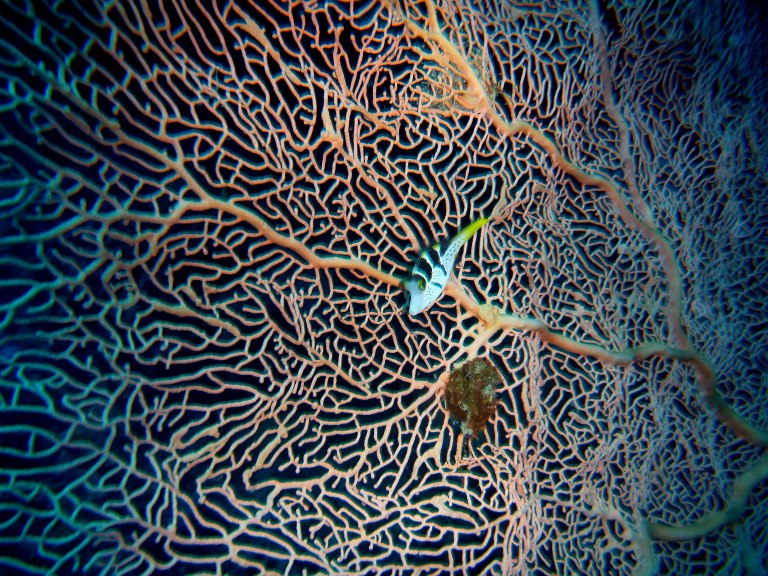
Lost in its Comfort!

P1060132

This dwarf puffer fish (Carinotetraodon travancoricus) was lost in the comfort of this wide giant gorgonian, perhaps it swam directly in the midst of humongous fan and was trap in a maze like in a net! I caught up with it while swimming in a wall in the marine sanctuary of Sumilon Island, Cebu. Another example of symbiotic relationships in marine world!

Have you been in the depths of southern Cebu?