Anemone!


P1050966

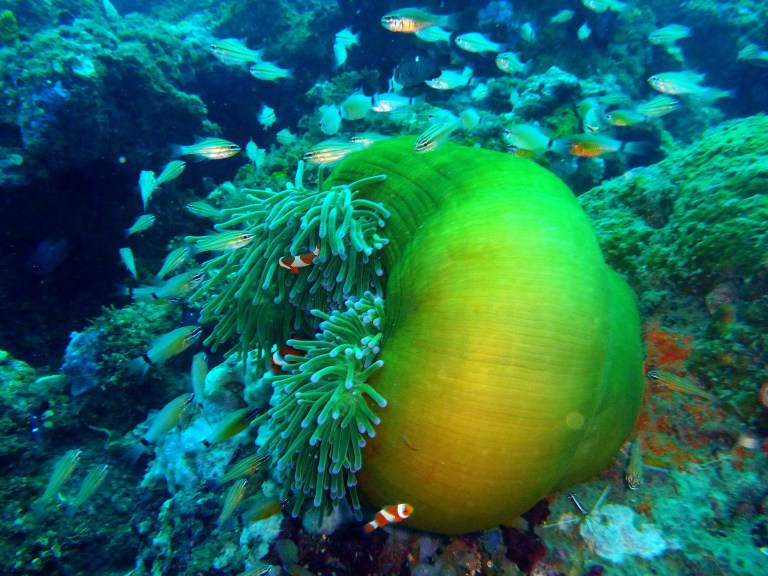
Spotting a pair of clownfish underwater always means they are near an anemone or most likely swimming and playing hide  and seek over a bloom of anemone. Anemones are named after a terrestrial flower, but it’s actually a marine animal.

Of the over 1,000 anemone species that live in the ocean, only 10 species coexists with the 26 species of tropical clownfish. Within these species, only select pairs of anemone and clownfish are compatible. Together, they are obligatory symbionts, which means that each species is highly dependent on the other for survival. Symbiosis between the two species is achieved in a variety of ways including a mutual protection from predators, an exchange of nutrients, and the clownfish’s tolerance of anemone nematocysts.

The relationship between the sea anemone and clownfish allows the other to flourish through symbiosis. They are mutually dependent from each other.  The  above explosion of colors was in Mag-aba Deep Wall in Pandan, Antique!

Choco Chip Star

P1050888

Have you heard of or encountered this sea star?

Protoreaster nodosus, commonly known as the horned sea star or chocolate chip sea star is a species of sea star found in the warm, shallow waters of the Indo-Pacific region like in the Philippines.

The species possess rows of spines or “horns”; black conical points arranged in a single row, radially on the dorsal side, which may erode and become blunt. These dark protrusions are used to scare away possible predators, by looking frightening or dangerous. On the ventral side, tube feet, purple in color (or pale, transparent pink), are arranged in rows on each arm. Most horned sea stars found are a roughly rigid five-pointed star-shape with tapering arms to the end, although there are anomalies like four or six-armed specimens; they may grow up to 30 cm (12 in) in diameter. The sea stars are usually colored in shades of red or brown, but can be light tan, the color of cookie dough. This appearance, combined with the small horns on its dorsal side, give the sea star a look similar to that of a bumpy cookie.

Other commensal animals like shrimps, tiny brittle stars and even juvenile filefish can be found on the surfaces of this sea star. It can be attributed to its protective nature, since there are few predators that would are eat this animal.

This horned sea star is not always found in every site but it could be in a colony in some areas. We found this in the midst of sandy slope over some soft corals in Sarangani Bay!

Tricky Octopus!

common-octopus
Such cool critter! Photo courtesy of http://www.nationalgeographic.com

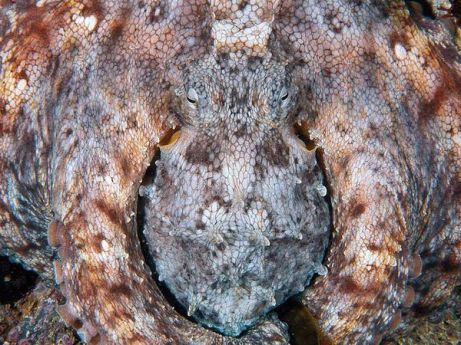
Descends most often are with surprise encounters, almost always I ask the dive guide what to expect down there.  The depths as always is unpredictable, few critters could just pop up in an uncanny way and it  always fascinates me observing their ways. Recently while diving in Sarangani Bay, after an encounter with a turtle, blue ribbon eel and observing mounds of artificial reef and maneuvering with the tricky current I thought was enough and paid-off my long trip to the south. But few minutes before we had our safety stop, a pair of keen eyes from our DM noticed the brownish critter over a reef crevice. It’s large bulging eyes popping out from the hole, lurking and stationery, it never thought it can attract passers-by. Observing it closely I failed to take photos!

Watching an octopus in its natural habitat was interesting,  our presence disturbed it, provoking to come out in its lair. Well, the octopus was courageous and stood its ground, it didn’t swim away quickly but stayed defensively and before it left shoot a cloud of black ink! It fled nonchalantly in front of us, such cool critter.  With such cunning ways, no wonder it is considered the most intelligent among invertebrates.

Here are few interesting facts about the common octopus:

  1. Octopuses have three hearts. Two of the hearts work exclusively to move blood beyond the animal’s gills, while the third keeps circulation flowing for the organs. The organ heart actually stops beating when the octopus swims, explaining the species’ penchant for crawling rather than swimming, which exhausts them.

  2. Octopus arms have a mind of their own. Two-thirds of an octopus’ neurons reside in its arms, not its head. As a result, the arms can problem solve how to open a shellfish while their owners are busy doing something else, like checking out a cave for more edible goodies. The arms can even react after they’ve been completely severed. In one experiment, severed arms jerked away in pain when researchers pinched them.

  3. Octopuses have blue blood. To survive in the deep ocean, octopuses evolved a copper rather than iron-based blood called hemocyanin, which turns its blood blue. This copper base is more efficient at transporting oxygen then hemoglobin when water temperature is very low and not much oxygen is around. But this system also causes them to be extremely sensitive to changes in acidity. If the surrounding water’s pH dips too low, octopuses can’t circulate enough oxygen. As such, researchers worry about what will happen to the animals as a result of climate change-induced ocean acidification.

  4. Octopus ink doesn’t just hide the animal. The ink also physically harms enemies. It contains a compound called tyrosinase, which, in humans, helps to control the production of the natural pigment melanin. But when sprayed in a predator’s eyes, tyrosinase causes a blinding irritation. It also garbles creatures’ sense of smell and taste. The defensive concoction is so potent, in fact, that octopuses that do not escape their own ink cloud can die.

  5. After mating, it’s game over for octopuses. Mating and parenthood are brief affairs for octopuses, who die shortly after. The species practices external fertilization. Multiple males either insert their spermatophores directly into a tubular funnel that the female uses to breathe, or else literally hand her the sperm, which she always accepts with one of her right arm (researchers do not know why). Afterwards, males wander off to die. As for the females, they can lay up to 400,000 eggs, which they obsessively guard and tend to. Prioritizing their motherly duties, females stop eating. But she doesn’t starve to death–rather, when the eggs hatch, the female’s body turns on her. Her body undertakes a cascade of cellular suicide, starting from the optic glands and rippling outward through her tissues and organs until she dies.

NB.  Facts from http://www.smithsonianmag.com

Orange Nudi

P1050868

This nudi (risbecia tyroni) is frequently found on pairs in single file, the slug at the back using its head to maintain contact with the one at the front. Tyron’s nudibranch as they are called have an ingenious defense system, just like other nudis they are fond of eating poisonous prey.

Indeed, one needs a keen eye to find them, they are silent and most often lurking on soft corals. We found this in the depths of Puerto Ptincesa, while the viz was far from good we caught sight of it in the yellowish reef almost hiding in the colors. But it was all alone, silently waiting perhaps for its prey.

Have you encountered this nudi?

Holiday Cheers!

P1050047
Christmas Tree Worms in red, blue, white, yellow!

Even marine life has its own way to display, in accord with holiday season. Reef systems most often gather various critters which  obviously offers a colorful milieu. I was quickly passing over a large rock coral with these colorful  worms, miniature tress sprouting all over. Such a wonderful sight, prompting me a smile. 🙂

My passion for the depths urge me again to make room for my last dive of the year. All the hullabaloo didn’t keep me tied, and again prod the inner mermaid in me to disappear into the depths, to another world.

Holiday cheers to everyone!