"Now more than ever do I realize that I will never be content of a sedentary life on the surface, I will always be haunted by thoughts of being drenched elsewhere"….
Trips during the month of December especially flying is normally shunned even on official matters, I always decline politely and just delegate someone else if there is a need. My year-end dive escapades (if there’s one) were always near my base, my dive buddy perfectly understood my ground. This year (2025) however, was an exception. … Read more Year-End Diving Adventures in Anilao
Descent to depths is always a pleasure but combine it with heights, is I would say pure indulgence and what a joy! 😊There are places close to my heart that have this perfect combination but obviously not within my reach, distant travel and careful arrangements are necessary. Truly, it’s pure bliss having this combination in … Read more Combining Heights and Depths: A Journey Through Nature
Aiming for International Women Dive Day was my original plan after having missed it in the past years but it was unfortunate the weather didn’t cooperate. The dive shop explained that visibility was not good and dives can be done the following day keeping crossed fingers and hoping it would be clearer enough for the … Read more Exploring the Depths: Birthday Dive Trip Recap
The quick get-away in Camiguin Island this summer was again another time to relax, recharge and remind myself I need to be on the road again! While I was planning for an escape to my go-to diveshop, my buddy randomly suggested for a quick dive trip wherever I want! 😊Apparently, my happy smart choice was … Read more Sustainable Diving in Camiguin: Clean-Up and Relaxation
After a wonderful sojourn and matching discoveries in Sibaltan, another diving trip was put to order in June. Yes, in summer like it used to be! For some time, I was aiming and wanted to be back in Cabilao Island but conditions were not favorable, a weekend was too short for the trip. Our instinct … Read more Diving Adventures in Moalboal: A Return to Paradise
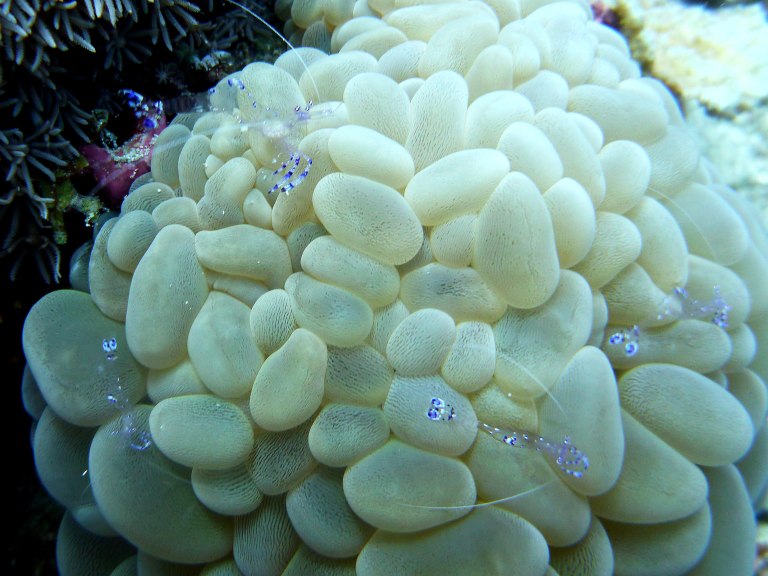
They are almost translucent, keen eyes are necessary to find them!
Also known as Crustaceans, Carid Shrimps, Commensal Shrimps,Bubble Anemone Shrimp, Philippine Shrimp and Anemone Shrimp.
This transparent critter can be found only on bubble coral, its glass-like body has purple antennae and purple line down body. They feed on parasites, algae and plankton.
Often if a divers hand is near to a cleaner shrimps, they will hop on board and perform a manicure!
Carid shrimps occur worldwide in almost every habitat, from sea water to fresh water and can be found all over the reef. They are generally respected by other creatures, often sharing burrows and holes and working as housekeepers. They will wave their antennae around to attract customers, they then proceed to clean outside and inside the creatures mouths, gills and more!
Simple yet too rich and beautiful, it is true that beauty is more than what is visible!
In October, we decided for a quick trip to Olango Island, if you fly over Cebu you can’t miss this mass of land widely surrounded with sea flats and reefs. Reef, that is obviously home for diverse marine life. Actually, the island is quietly known as migratory path of birds, there is season for these species covering the wide flats of the island! Apparently, our purpose to cruise for the island was for its depths more than the birds. It was a quick getaway and we lack sufficient time to linger for the southern part of the island.
Floating with this scenery above me was all consuming!
The week has been overcast and wasn’t sunny enough, and for that weekend cruising to the island was not easy. Fortunately, our dive operator was kind enough to fetch us from Mactan port. But the big waves keep tossing the boat and getting on the vessel was more than tricky and challenging. I made it though, waited for exact timing and managed quick steps over the gangplank and run for the inner chamber of the vessel. Well, a diver should be fit enough to bring oneself on the boat, come high waves or gusty winds!
Surprises in the Depths
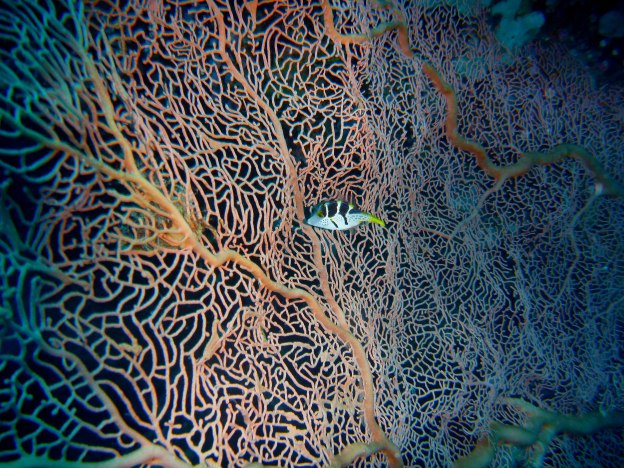
This wide seafan is home to many critters
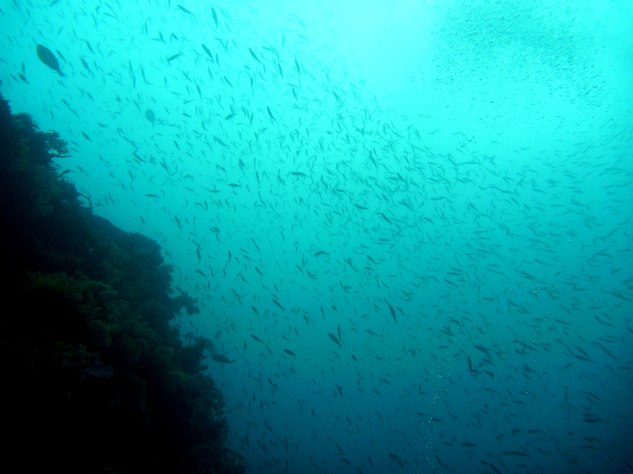
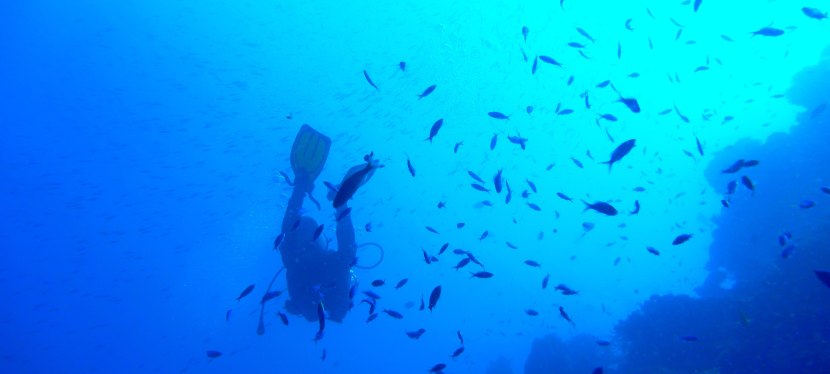
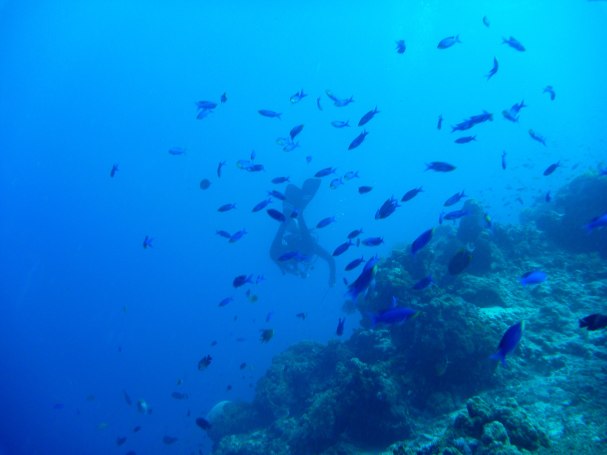
Surprisingly, the waterfront of the island was calm and its water suitable for the dives, there were dive boats anchored as we passed along for Mokie Dive Center. It was late already and after the preliminaries and briefing from DM Opong, we geared up for our first descent at Baring Wall which is just nearby. I guess our DM was too careful to bring along two more guides during our dive, just being safe for sure. We went down to a sandy slope with scattered sea grasses at about 4 meters until we came to a wall filled with soft corals, hydroids, whips and crinoids. As I look up, there were so much juveniles prying around, surrounding us as we swam. It was like that – so wide and blue, feeling weightless and floating surrounded by them. It was a grand sight and being in their midst felt surreal. The wall was literally covered with life, so vibrant and colorful. There were enormous sea fans and varied soft corals. The black triggers seemed a common sight in the area darting now and then before us. Then as we passed a crevice, a flood of fish came over us obviously intimidated by our presence, in a sense we are intruding their abode. We sighted also giant groupers, damsels, chromis and wrasses. We ended our dive after 44 minutes with my air still at 1200psi.
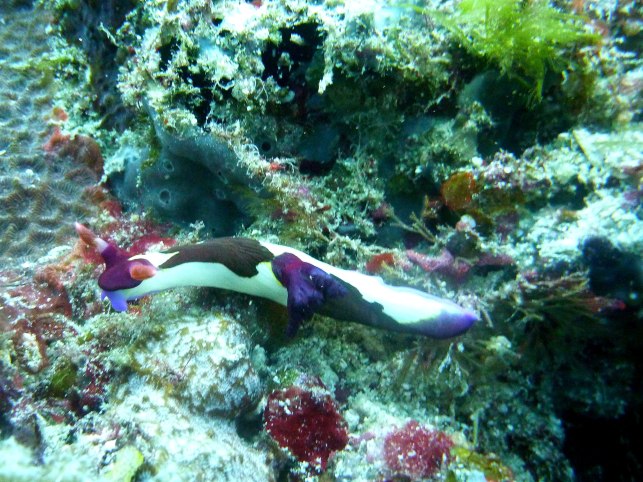
This nudi was crawling fast perhaps looking for food!
After an hour of surface interval at the diveshop, we prepared for our last descent at the house reef almost 3:00 in the afternoon already. The weather was bit kinder, it was still overcast though but the waters was warm enough for a relaxing dive. Our kind guide suggested for the house reef, we went shallower but we had lot of sightings more than I expected! 🙂
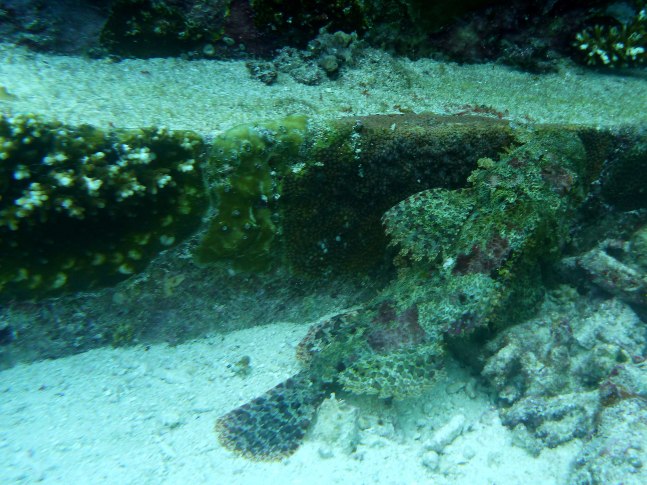
Can you see the stonefish?
So our first stop was at the remnants of a wooden boat, it doesn’t look like a wreck anymore yet the fragments had an active fish life. Surprisingly, it has become an artificial shelter of many species. We found stonefish, stationery as always just waiting for prey, and juveniles silently wiggling endlessly. A herd of sweetlips came close, curiously watching me but maintaining its distance carefully. Anthias, damsels, chromis, wrasses, angels, banners, triggers, pilot fish, striped eels and lot more! Invertebrates also abound – at least five species of nudibranch, Christmas tree worms and shrimps. I was glad to find a moray eel, out from its lair on the sand. Another curious critter, it didn’t budge as I got nearer for a photo! There was a giant batfish like a pup, followed us all the way through until we had our safety stop. It was our company silently watching us, so amusing! And as we are nearing our safety stop, we had our big surprise as we saw a giant lilac crown jelly (chepea chepea) floating before us. So amazing, it was my first encounter after many years of diving, indeed there is always something new in every dive!
This is dragonet with its pectoral & caudal fin opened as it flew away!
Lastly, during our safety stop preparing for ascent just below our boat, I found a dragonet on the sand! And opening its pectoral fins, went swimming or flying over a distance catching up with another one. Yes, a couple of dragonet near our boat, when this specie is hard to find in other places! 🙂 We ended our afternoon in the waters filled to the brim with our sightings. After 53 minutes, I still had 1100psi and we had our deepest at 23.9 meters.
Treasures to Explore
Olango is worth another visit to discover more of its riches in the southern part and set foot on its vast tidal flats. Its treasures lies both on the surface and its depths.
The island is a diverse coastal ecosystem consisting of extensive coralline sandflats, mangroves, seagrass beds, and offshore coral reefs. The island’s mangroves are most extensive in the Cebu province, and its offshore corals are home to scores of various marine species.
It is a wildlife sanctuary and is one of the seven best-known flyways in the world for migrating birds. The 920-hectare Sanctuary is a haven for migratory birds from Siberia, Northern China, and Japan. These birds flock to the island seeking refuge from the winter climate of other countries and it supports the largest concentration of migratory birds found so far in the Philippines. There are 97 species of birds in Olango, 48 of which are migratory species, while the rest are resident birds of the island. The birds use Olango as a major refueling station as well as a wintering ground. The birds stop by the island on their southward journey to Australia and New Zealand and on their journey back to their nesting grounds. (from wikipedia)
Next time I must visit Olango around the months of July to November just in time for winter in the Northern Hemisphere so I could catch glimpse of birds resting in the reef flats!
Have you been to Olango Island or Mactan, Cebu for that matter?
Marine debris is not only unsightly, it’s dangerous to sea life, hazardous to human health, and costly to our economies. Marine animals become entangled in debris, and even mistake it for food – often with fatal results. Divers, swimmers and beach goers can be directly harmed by encounters with marine debris or its toxins. The environmental damage caused by plastic debris alone is estimated at US$13 billion a year.
Let our little efforts can make big changes in the underwater world!
Reinforcing our efforts in reducing the impacts of our consumerism habits, we can reflect each time we plan to do our grocery errand at the supermarket. Our choices, big and small in the goods we buy including its packaging will either aggravate or mitigate the ever worsening deluge of trash in the environment.
Here’s hoping that we become all conscious consumers aware of the impact of our wastes everyday. Let this be a challenge, a resolution for the year 2017!
To an ordinary eye, these are just two dried leaves floating over the sand
Let me start my post for this year with amazing sea life, a special find in my last dive in 2016, a specie which never occurred to me until we ascend and asked our DM what it was. It was just fortunate I took a snap descent enough for posting.
Have you encountered a ghost fish in any of your dives?
I think they got this name as they are sometimes suddenly found or seen in a particular place and they only stay a few days or weeks before they disappear mysterious like a ghost.
They are extremely seasonal and are mostly found only a few months of the year. Furthermore, in the current they move perfectly along with the moving arms of the feather star so that they are as good as invisible. A lot of reasons thus why they are so hard to find.
We swam up the sandy slope drifting with the current preparing for safety stop, when our DM pointed out these two brownish matter. Pausing for a moment watching intently and wondering what it was but suspecting it was something I should not ignore. Then hastily snapped two photos.
At once glance, it can never be suspected as fish. They barely moved but swayed and drifted with the afternoon current which was an intelligent camouflage as dried leaves. I suspect the big one is pregnant evidenced by its bulging mid-body probably the tummy.
The marine world is definitely filled with wonderful creatures, miraculously it appeared before us when barely ten months ago in our dives at the bay we never found any ghost pipe fish. There was much abundance you never know what you find in your next dive. It was a perfect surprise for us!
The friendly domesticated whalesharks in the waters of Tan-awan in Oslob town have drawn so much curiosity from tourists, foreign and locals alike. In short, all people heading to this town in Southern Cebu are in search for the gentle giants. This once sleepy town is now bustling with travelers and obviously economic activity flourish, thanks to the biggest fish!
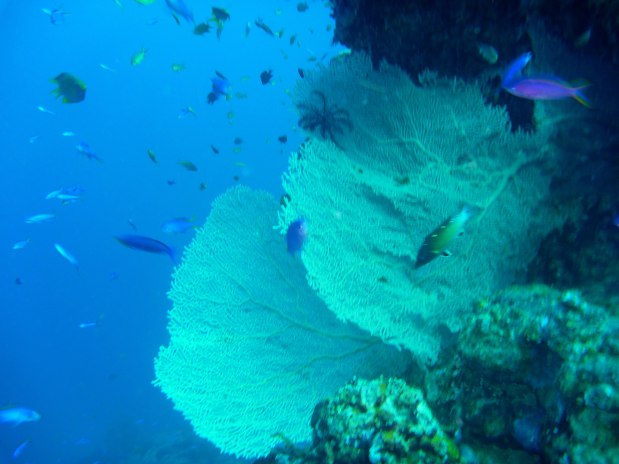
Fishes and crinoids take refuge in wide gorgonians!
This coastal town however, has a more than to offer in terms of marine life and that’s where we set out in July for a dive trip. We arrived aboard a bus from Cebu City filled with tourists, all of them aiming for the whalesharks. My blue diver heart cried in protest for this unethical and disrespectful interaction with marine life. They are supposed to be in the wild swimming in the depths. It was so pathetic…
Island Treasure
If you have traveled down south of Cebu, you will never miss Sumilon Island along its coastal road in the southeastern tip of Oslob. It is a 24-hectare (59-acre) coral island off the coast of Bancogon. It is the first marine protected area in the Philippines; created as a marine sanctuary in 1974 under the guidance of the Silliman University Marine Reserve of Dumaguete City in the nearby province of Negros Oriental.
Just watching electric blue anthias was calming enough!
We arrived early at Brumini Resort, earlier as expected by our DM and we still had enough time for coffee to perk us up after our sleepy bus ride. It was another exclusive dive for me and Angel, no other divers for the day since everyone was out for the whale sharks! We set for the island a little past 8:00am, unfortunately the picturesque sandbar I was hoping to see was nowhere, it was high tide then. Not far were trigger boats heading for the whale sharks point, not one or two but many!
Our first descent was in Landscape Coral, some sandy slope hosting a variety of tropical fishes such as anthias, groupers, goatfish, herd of bannerfish, butterfly fish, triggers and more. Surprisingly, a black tip shark appeared vaguely from my point! A herd of mackerel neatly piled themselves and paraded before us, such a sight! And there was cuttlefish and as I slowly came near hoping for photos, it swam backwards curiously watching me. 🙂 The golden and blue anthias wiggling over corals were so engaging, watching them silently was perfectly calming. Then, as we float weightlessly, something unusual came floating towards me, I almost wanted to reach out to touch. It was a transparent specie appearing in shape of fish, floating and just drifting though the waters, it was a strange encounter! We drifted until we got to a wide coral field, the current becoming intense when we got in a corner to the depths. We finned endlessly as we slowly ascend watching the coral field, holding hands to be sure not to be separated as we swam back for the boat nearby.
We asked our DM to have our surface interval down the waters over the sandbar, if it was low tide we could be walking on its white sandy surface or just lounge on its white beach. There were lot of people on the waters as well as in some kind of waiting shed in the rock cliff, for the guests I guess. We tried to gather the trash floating before us brought in by the rising tide, if only all the people out there could take one trash at a time, it will be free of all the eyesore in a flash. If only…
There could be many forms of life taking this wide gorgonian as their abode!
Our next descent was in the marine sanctuary, which was again perfectly rich with diverse marine life. There was trumpetfish, silver jack, triggers – well, I was eyeing with the titan trigger making sure I won’t attract his attention! 🙂 The golden and lilac anthias were there again contently wiggling over the green corals. There were bivalves also, barrel sponges, cucumbers and colored anemones. The giant sea fans in yellow and blue also decorated the area. The banded sea snake slithered along perhaps looking for prey. We passed crevices and overhangs curiously looking for macros. I found four nudis in just one location, perhaps they were a family. I sighted boxfish, puffer fish, goatfish, banner fish, moorish idol, angels and damsels. I sighted also a herd of sweetlips swimming coyly, so absorbing just watching them. We got to a wide coral area for our safety stop curiously hopping around. After 48 minutes, I still had 120 bars of air when we ascend.
Reflections
Getting into the depths is far better than feeding and swimming with the whale sharks on the water surface. The depths of the island or Oslob for that matter, has much more to offer. Apparently, Oslob is more than the whale sharks, its depths held much more interesting marine life! As we rode our transpo going further south, I was reflecting how long can they sustain the poor butandings entertaining numerous people everyday. This practice has greatly disturbed the ecosystem. I wish the people of Oslob reflected on this…
Will you interact with Oslob whale sharks this way?









 Life in the Great Beyond
You must be logged in to post a comment.