"Now more than ever do I realize that I will never be content of a sedentary life on the surface, I will always be haunted by thoughts of being drenched elsewhere"….
Nudibranch (Nudibranchia) or simply called nudi in diving community are wonderful creatures, with odd shapes and vibrant colors one can’t miss them as it crawls on soft or hard corals among the reefs. They are lovely to behold and if you are sensitive on micro and subtle critters, these animals are exceptional.
Here are few facts I gathered about this lovely animal:
There are over 3000 identified species of nudi, it would take too wide and long to encounter them all
They are color blind or generally have poor vision and can only distinguish dark or light lumination
Nudis are hermaphroditic, which means capacitated with both male & female reproductive organs. Being solitary in nature, it needs to maximize their mating ability for reproduction
It has very short life span, it can only live not more than one year so there is no chance to encounter the same nudi in the next dive
They got their colors from their food, it has the ability to absorb and incorporate the tint & shade of their prey into their tissues such as anemones or sponges
Generally, it’s not for human consumption – often referred to as “butterfly of the ocean” due to vivid vibrant color and their intense toxicity – generally their loud color is a warning sign!
I love nudis and my dive won’t be complete if I don’t find one, I would conclude that the particular reef lacks the necessary as habitat for the critters and so not healthy. And I would reflect that perhaps I went too fast not to notice if there was one. With more than 3000 species, one can imagine how vast and mysterious our ocean can be!
In November, we head southeast down Misamis Oriental and revisited Duka Bay to relish once more its impressive depths. The bay has been a favorite back when I was just starting my dive pursuits. It is just few kilometers from Cagayan de Oro and I have good friends managing a diveshop in the location, this was my playground during my advance open water (AOW) course. The local government also exerted efforts for marine conservation and preservation – marine sanctuary maintenance, installation of artificial reefs, coral restoration and dive clean-ups. Their labor was intensive and the support for them was gratifying. The site is practically a good destination for weekend get- away.
Filled with marine life!
The weather cooperated with us on that Saturday morning when previous days it was pouring hard, mysteriously the viz was good enough for our dives. There were no other divers so it was again an exclusive one for us. Edward, Jolem, Badette and Lemuel of Duka Dive & Aquasports were there for us.
Paying respect for Our Lady Star of the Sea
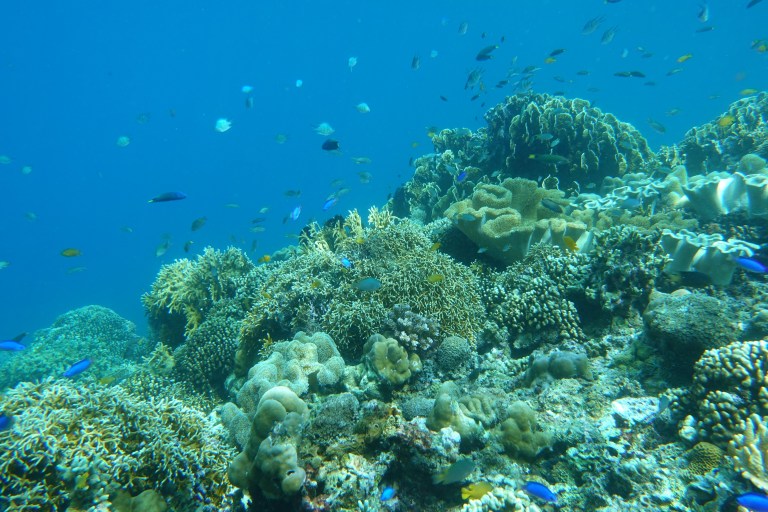
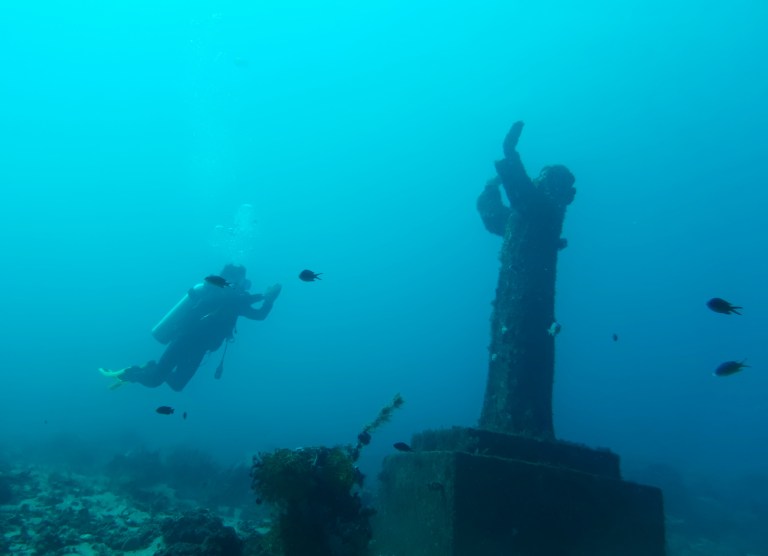
We were aiming for Mother Mary’s statue which is something new in Paradise, it was planted early in CY 2017 and has become an attraction in the bay. It was our first stop, she was there standing in the middle of white sandy slope away from the crowd. So alone, so serene. It reminds me of MUSA in Cancun, Mexico – but with only one statue it is a far cry. Marine critters started to inhabit the statue, actually promoting coral life. We proceed to that big crater full of tropical fishes, I positioned in the by-side, paused and watch in awe the busy stream of resident fishes swimming, darting, wiggling before me. We passed alibuags sending shivers as it was too cold to ignore. Duka is famous for these fresh water springs underwater, how uncanny nature is! There was a parade of giant snappers and a big turtle appeared. We entered a small cavern full of golden cardinals, swimming madly as we got near! The area is now more full with soft & hard corals, decorated with crinoids, whips and other invertebrates. Still a paradise, as it was!
Our last dive was at the Aquarium with an inner reef for the wide coral field and outer reef to the deeper part of the site. We descend on a sandy slope unto a large colony of garden eels, so many of them! And again, I linger for a moment to just watch them come up from their burrows inch by inch. Their shyness is endearing! There were lot of tropical fishes in variety, few nudis and a cluster of giant clams. We found too stonefish and a juvenile yellow frogfish. We roamed around the coral fields, biding our time and watchful for critters. There were alibuags again scattered, and true to its name as it was before, it is indeed an aquarium!
Just marvelous, the bay can never be outdone in its diverse marine life, and coming back after some time with a deluge of sightings was refreshing enough and brought back memories how replete this once my playground in the early days!
In my year-end dive, we discovered this reef as we went around in the island sanctuary, perfectly decorated with feather stars, whips, soft & hard corals. Very symbolic and a gentle reminder for our love of the ocean and marine world in general. Just needed keen eyes, I was beaming when we spotted this corner! 🙂
We’re now into the swing of the new year putting in place each one’s agenda, may the force of love our motivation in our journey – our passions, dreams, and aspirations.
Indeed, the ocean is worth the love we could give. As Dr. Sylvia Earle puts it, ” No ocean, no life. No blue, no green. No ocean, no us.” Let’s keep the heart beating, it’s time we return the love!
Still our penchant for seeking less known sites is limitless. As we all knew, the island province of Bohol is a gem, it is undoubtedly replete with many wonders. Last year, we felt so blessed after diving in the town of Anda – it was incredibly rich we regret discovering it just lately. So, we were off again to the province and endured multiple mode of transport to reach the town of Loon, finally cruising to this tiny unassuming island one weekend in September. It was a plane, ferry, bus and tiny boat ride all to Cabilao Island. The island has been in my list years back but the arduous trip that won’t surely fit on a weekend deterred the schedule. Recently, Angel discovered reaching the other side of Bohol via Tubigon, definitely shorter and cheaper than via Tagbilaran! So, as soon as I got back from the July rendezvous, I booked my Cebu tickets for this trip.
All in a Rush
Polaris Dive Resort is a self-contained, homey & environment friendly haven. Add diving, and that’s all too perfect for me!
Another hectic weekend awaits us, so things were all in a rush but thanks God all our transport connections went fluidly as planned. We were catching our breath as we do not want to be late, Europeans are time conscious and it is discourteous to keep others waiting. We arrived and welcomed warmly at Polaris Dive Resort just in the nick of time, enough to have a quick but relaxing breakfast and gather ourselves for the day’s dives. DM Jun assured us not to rush, we were informed that three couples (all Deutsch) were booked for the day obviously we were arranged to join them.
Pulo Hospitality
Hey, can you find the harlequin shrimp? 🙂
The location and amenities of the resort was impressive and exactly what one needs for an escape, add diving and that’s perfect haven for me. J We geared up after the preliminaries and piled all eight divers in the boat for our first descent at the Lighthouse, which was a short 5-minute ride south of resort shores. We dropped unto a sandy slope filled with soft corals down to a wall, we chance upon a colony of garden eels which quickly hid in their burrows when we got near. I’m always fascinated with them, and again I paused and waited they would come out again, they did slowly inch by inch! We stumbled on macros – few nudis, glass shrimp and a crab mimicking on soft coral. Every turn we peek on corals for critters. The highlights for me was the yellow
Face to face with a yellow frogfish!
frogfish perched on a large plank of yellow rubber coral surrounded by crinoids, adapting its yellow surroundings. I waited it would yawn, but it only opened its mouth a bit perhaps catching some air, at least it was not upset with our intrusion in its abode. It was a good subject directly facing us, so the Deutsch divers feasted for photos! We explored more – the perennial clown fish forever teasing over anemones, ghost pipefish like dead leaves (!), stonefish and nudis again. Then over a sandy part, our DM pointed out a couple of black/white organism clinging on rubber coral, poking a bit it went white all over – it turns out to be an egg cowrie! We linger for our safety stop over a sandy slope covered with corals and sea grasses and found last minute a stonefish, hairy crab on bubble coral and a herd of striped eel fish. We separated from the group and ascend by ourselves in the shallows towards the shore, after 90 minutes. I still have 60 bars with 29.7 meters as our deepest. So far, this was my longest bottom time!
Macros are everywhere, a crab was secretly hiding among this colorful soft coral!
Our surface interval was spent for our light but relaxing lunch of penne pesto pasta and korbis soup, we had enough time too for some breather in our cottage. The quiet surroundings under the swaying coconuts and trees with blooming hibiscus would surely lull you to sleep. J I have to drag myself from the rattan duyan for our next dive at 2pm.
A scorpion fish!
The afternoon descent is at The Chapel, which is nearby too parallel the resort shores. It is located near a small chapel which according to DM Jun where fishers drop-by before setting off to fish. Our DM promised a diverse marine life in this lowly site. Indeed, we dropped off on a colourful reef where in few minutes we found the electric clams, they lurk on overhangs or crevices and emit somewhat vibrating lights from their opening. Angel pointed out to me a shy moray with its head barely out from its hole, it didn’t like our intrusion. L Then a harlequin shrimp barely noticeable clinging on soft flowery coral, glass shrimps on anemone, another minute shrimp on flat hardened surface over anemones, few nudis – critters were everywhere! We went on a swim-through with our DM carefully navigating getting a streamlined test, it was perfectly smooth! A lone silver barracuda was teasing us, wondering where its companions are. Damsels, groupers, triggers, sand perch, wrasses, chromis, fusiliers, butterfly fish, angels, anthias and more. There was this adorable blenny peeking from its abode as if giving us a hello, its curiosity was endearing. We were having our wrap-up as we get off for our safety stop, when a large herd of striped barracudas appeared in view. We swam quick before we lost them, it was incredible that at five meters we got a full view of the herd! J I still have 80 bars when we ascend after 73 minutes. It was wonderful, with lot of sightings and diverse environment we were more than an hour underwater for both dives. My heart was filled with gratefulness for all the discoveries.
Parading in the coral fields!
We pass-off for night dives and choose to unwind at the patio savoring the twilight glow and eventually had a quiet alfresco dinner listening to the waves behind us. The day was just full deserving a good night’s rest.
Final Touch
Leaving the island wasn’t complete without attending an early mass at the Centro, exploring the shoreline towards the Lighthouse and Punta Baluarte Eco-Museum. It offers a lovely view of the sea minus the crowd and modern development, just sheer island charm and unspoiled serene setting.
Hidden, idyllic and purely designed for unwinding, another unmatched destination just waiting to be explored and enjoyed is Cabilao Island. Actually, it’s more than just a destination, it’s an experience!
Travel Notes:
My itinerary for this trip
Last night flight from Cagayan de Oro to Cebu, 740pm – 50 minutes
First trip ferry to Tubigon, 445am – 2 hours
Van ride to Mocpoc, Loon – 1 hour
Habal ride to Pier – 15 minutes
Boat ride to Talisay, Cabilao pier – 10 minutes
Habal ride to Polaris Dive Resort – 10 minutes
Return trip has same route leaving the island early, to catch the last flight to Cagayan de Oro from Cebu
With the above itinerary, there is a need to stay overnight in metro Cebu
Ferries for Cebu-Tubigon route & vice versa has several trips daily, in Cebu they sail from Pier Uno
Polaris Dive Resort is a self-contained homey environment friendly resort which houses a 5-star PADI dive shop, lies in the western side obviously offering daily sunsets
The tiny triangular island of Cabilao off Loon town is literally surrounded with at least 14 dive sites
The marine world is indeed filled with wonders, and this electric clam is just one of them. Ctenoides Ales (scientific name) is a specie of saltwater clam, a marine bivalve mollusk in the family of Limidae. It is known by the names of electric flame scallop, disco scallop, electric clam and disco clam. The only bivalve known to have light displays, its soft tissues flashes light like a disco ball!
This clam normally situate itself on overhangs or crevices obviously for protection, secondly, the lighting effect is more visible in the dark. Recently, we sighted the critter while diving in Cabilao Island, Bohol. Our last encounter few years back was in Pescador Island, Moalboal. So far, these are the sites where I found this rare flashy clams.
According to research, the explanation of this flashing light comes from reflection of the ambient light – the clam have a highly reflective tissue on the very outer edge of their mantle exposed and then hidden very quickly, so the change back and forth from the white reflective tissue to the red tissue creates the appearance of flashing.
You must be logged in to post a comment.