"Now more than ever do I realize that I will never be content of a sedentary life on the surface, I will always be haunted by thoughts of being drenched elsewhere"….
Alcyonacea is an order of colonial cnidarians found throughout the oceans of the world, especially in the tropics like the Philippines. The name “Gorgonacea” is no longer considered valid and Alcyonacea is now the accepted name for the order. Gorgonians as they are called are also known as sea whips or sea fans and are similar to the sea pen, a soft coral. Gorgonians are closely related to coral. Individual tiny polyps form colonies that are normally erect, flattened, branching, and reminiscent of a fan. Others may be whiplike, bushy, or even encrusting. A colony can be several feet high and across but only a few inches thick. They may be brightly coloured, often purple, red, or yellow.
Last March while diving in Albay Gulf, it was surprising there were abundant sea fans in Pasig Out and Itom na Buya sites, I was quick to presume that its environment has started to regain its balance. Fan are normally feeding with planktons and particulate matters, obviously its waters now healthy enough to contain such compounds enabling the food chain of existing marine life. The area is laden with currents, although it wasn’t strong during our dives.
Gorgonians are classified in Cnidaria alongside the orders Alcyonacea (soft corals) and Pennatulaces (sea pens). There are about 500 different species of gorgonians found in the oceans of the world, but the are particularly abundant in the shallow waters in Indo-Pacific like the Philippines.
After discovering over a year ago that Legazpi has diving opportunities, I was back to explore Albay Gulf. It is not really known for scuba diving, I just thought it isn’t much exploited and it would be less crowded and I would have enough time taking it slow, down in the depths. Craning my neck looking for Mt. Mayon as my plane prepared for arrival, she was hidden by clouds even as we touched down. Seeing her countenance everyday was another inspiration for my three-day get away. I was noting mentally my to do’s for the day as I headed for my new house at Mayon Backpackers, located perfectly in the downtown area bit far from the dive shop. But going around the city all by myself was just as interesting as discovering one new place, surface or in the depths.
Morning Delights
My diveshop was too kind to arrange for my pick-up and being early had given me enough time to take it slow as I wait for my companions. Indeed, it wasn’t congested there were only two of us as their guests, I was joined to a 67 year old Japanese who just earned his certification few months back. Taking it slow as I wish!
Bubble corals were also abundant!
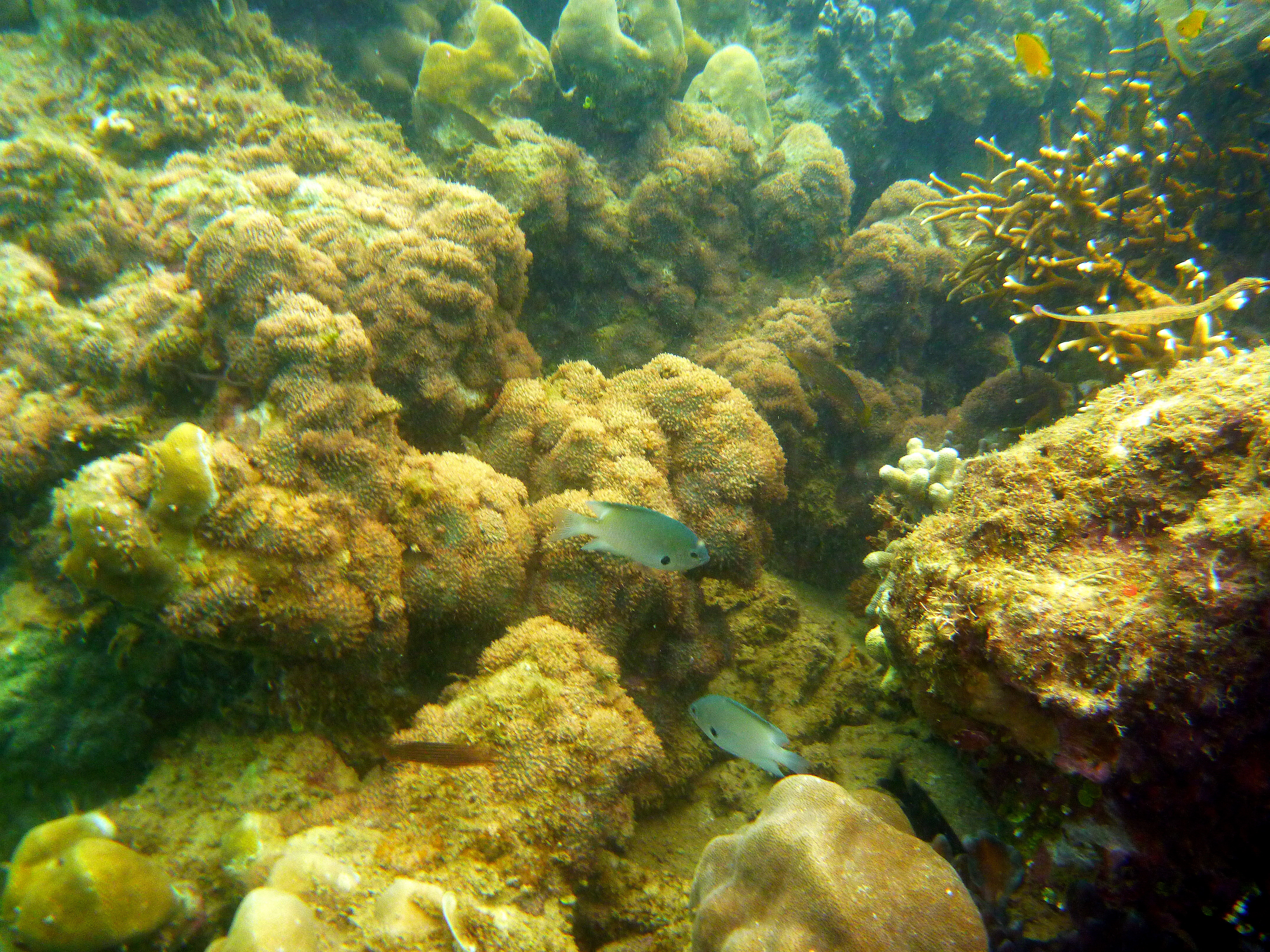
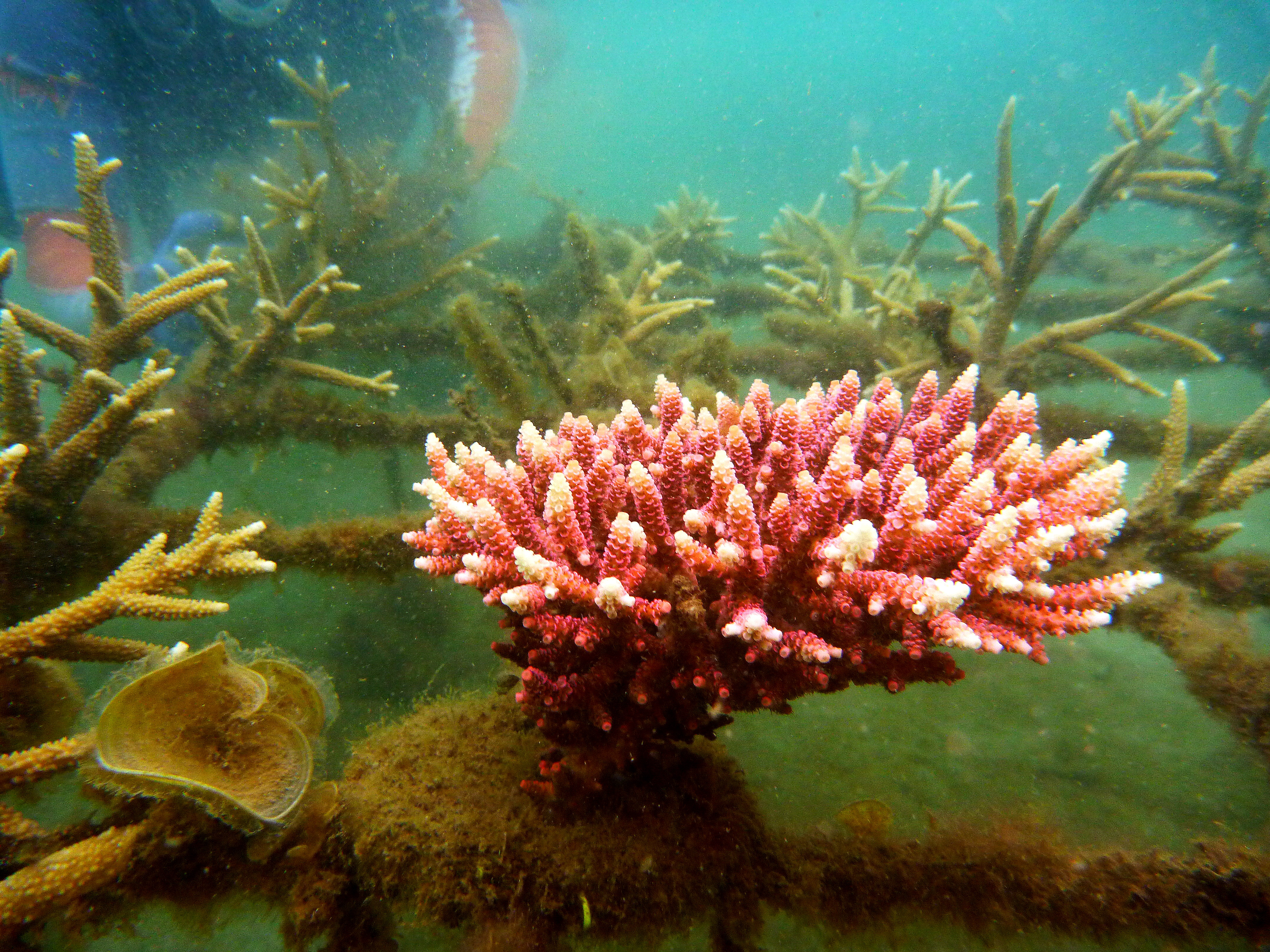
We cruised shortly to our first descent, DM Almar briefly introduce the site which they called as Itom na Buya (Black Bouy) which I presumed originally marked with black bouys. Mr. Jin Masuda of Pacific Blue have mentioned that restoration of the bay is on-going but it was surprising that the area was colorful and was filled with variety of corals including wide sea fans in different hues. Although the fishes were juveniles but it wasn’t totally devoid of marine life and it looks healthy. There were bubble corals, branching corals, rubber corals, whips, ferns, and feather stars. There were occasional juvenile nudis, and we found a shrimp lurking on the coral. We ascend after 47 minutes with air at 80 bars, my deepest was 25 meters.
There were lot of sea fans
Our second descent was in Pasig Out (there must be Pasig In!), a sandy slope which is not really far from dive shop shores. Our first sighting was a tombstone of diver who lost his life in accident while diving many years ago. It still standing there now covered with fossilized parasites. For sure, diving in Albay wasn’t something new and maybe the diver or the accident has been forgotten buried from lapse of time . Corals also abound in the area – bubbles, rubber, staghorns, spirals, seafans, whips, squirts and even crown of thorns. Although there was an area of coral rubbles the reviving and flourishing marine life is imminent. Juvenile fishes are contently hovering over corals! At noon, the waters went choppy already, not wanting to stay on the surface longer I carry my tank on my own. We ascend after 40 minutes with air still at 100 bars, my deepest at 22 meters.
Juveniles wiggling among the corals, marine life is obviously thriving in the area!
The view was perfectly glorious, my ascents and descents were decorated with the view of Mt. Mayon, watching her from the waters in a different angle was a unique experience! It was a great morning for our descents and my afternoon was more interesting. I had a long interval for my third dive which deserves another write-up. Taking it slow, you know! 🙂
My wish to explore Albay Gulf was granted, just a couple of days ago. Indeed, there is always beyond the surface. We paid respect to a diver who choose the depths as his graveyard. He died many years ago, cremated and his ashes sprinkled over this area, this must be his favorite spot. His tombstone is now calcified and encrusted with algae. The inscription is not readable anymore.
Just one of the highlights in exploring Albay depths!
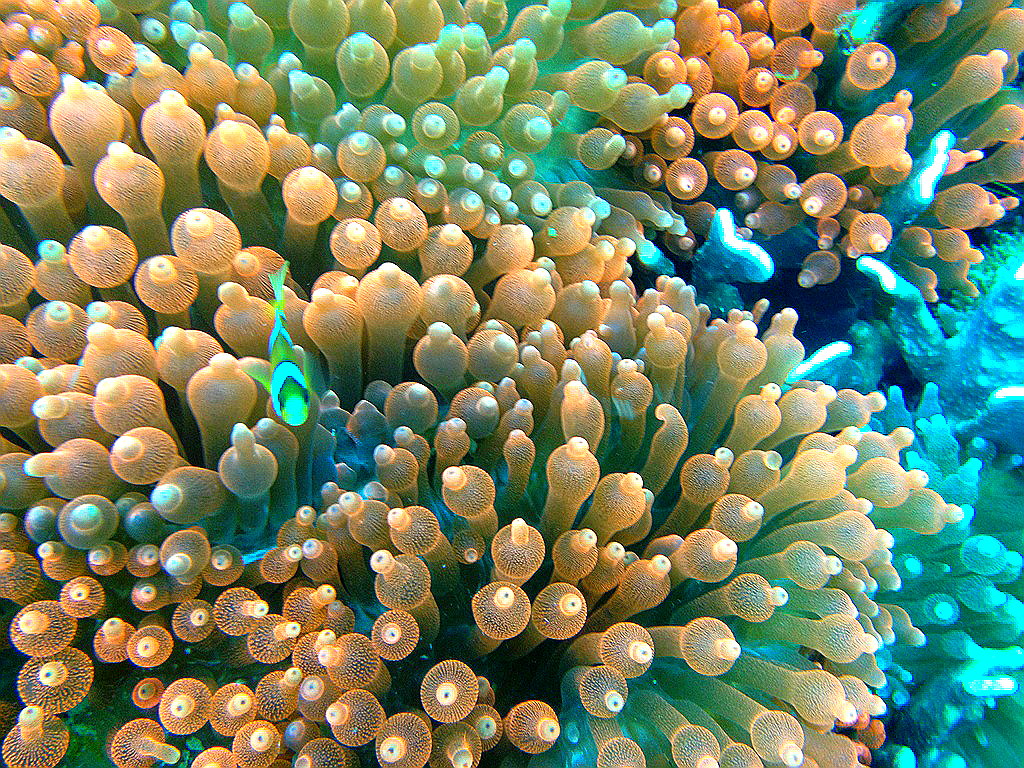
A clownfish furtively swam between the anemones polyps.
The fleeting trip to Surigao City late last year was full-packed yet our plan was amply covered. We have been planning to explore the city for diving and finding Mabua Divers more than a year ago was a blessing. It was unexpected to chance upon a dive operator, I was rejoicing I found one. So, my dive buddy just gave in to my whims. On a November weekend, we met up in Butuan terminal to catch up a bus to Surigao. Our hosts were too excited to have us for our dives.
Mabua is more than just the peebles and blue waters!
Fish life in Mabua depths
We arrived past 8am already with Dirk & Doris eagerly waiting for us, with almost everything ready – the rubber boat, boatman, gears and other needs. Our hosts warned us not to rush, it was comforting as Angel and I both had short naps during the night trip. Dirk showed us around their property that has on-going works for the the additional two floors of the building.
Deep in Mabua
Our boat sped off west ward as Dirk wanted to show us the neighboring shores and the lighthouse, and got back for our first descent in Looc. I went first but was carried away by the current, what did took them long to get off? A local fisherman helped and tow me to our boat until I was picked up. The slope was decorated with a small reef – corals, anemones, feather stars , juvenile fishes and hard corals. There were groupers, barramundi, puffers and nudis. The black leaf fish was a great find!
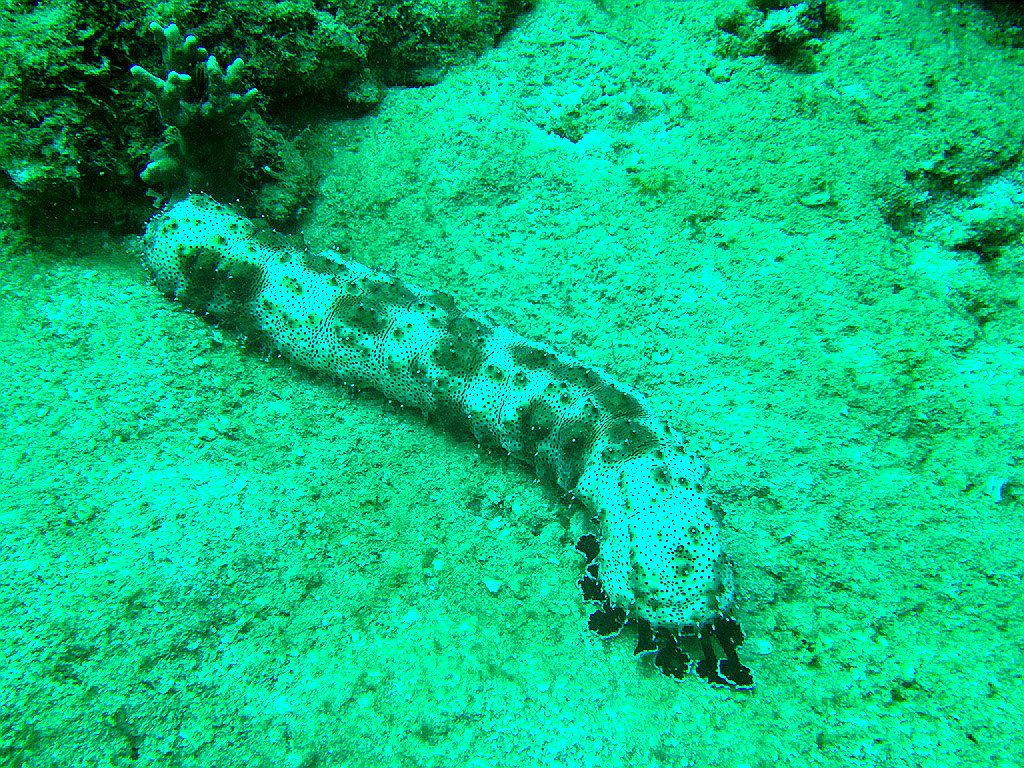
A sea cucumber crawling on the white sands!
We had a long surface interval, our hosts graciously entertained us with travel stories! Our next descent was at Mabua Rock, we dismissed it in the morning after Dirk failed to locate it. 🙂 It’s a big rock among white sandy area, covered with corals, anemones, crinoids, hydroids – with juvenile fishes swarming around. It has more active fish life, it was uniquely situated as if separated from other forms of life. The rock served as reef and shelter to variety of species. We found yellow leaf fish, lots of puffers, banded pipefish, dotted barramundi, nudis and a herd of striped eelfish. We noticed a seastar with its fingers deformed, like it has a disease! We made rounds again and again until Dirk signaled for our ascent. It was reviving to be in the depths again after almost nine weeks!
Relaxing with my friends in the depths!
Should you do a round trip Cdeo – Surigao – Cdeo in less than 36 hours? Quirky and rash but we had quiet moments to relax and savor life’s surprises. Indeed Mabua is more than just a pebbles beach as it was known, it has its own secrets beyond its unique shoreline and blue waters. It has its own mystery, just waiting for curious spirits.
Disclosures
After the dives, we rushed to Butuan City and had dinner in our fave cafe, Margie’s Kitchen, lingered and waited until it closed at 1am, then proceed to the bus terminal. We took the 2am aircon bus to CdeO, and arrived past 6am. Leisurely sat on a park bench in Divisoria, then had a sumptuous breakfast at another favorite, Vienna Cafe which opened at 8am. Just savoring precious moments in our favorite homey restos! 🙂
NB. Underwater photos courtesy of Angel using iPhone 4S with iPix.
A herd of striped eelfish stirring and searching the sand for food, this group was sighted while diving in Mabua, Surigao City
Although eels naturally thrived in freshwater, this specie inhabits marine waters and commonly sighted in Philippines. My sightings were usually juveniles in group wiggling as they swim in accord, incessantly stirring the sand. This specie feed on crustaceans, mollusks, worms and small fish. They appear to be harmless as they always shy away within close range, but all specie of eelfish are confirmed to be venomous! Beware then when you encounter them next time you dive.
You must be logged in to post a comment.